
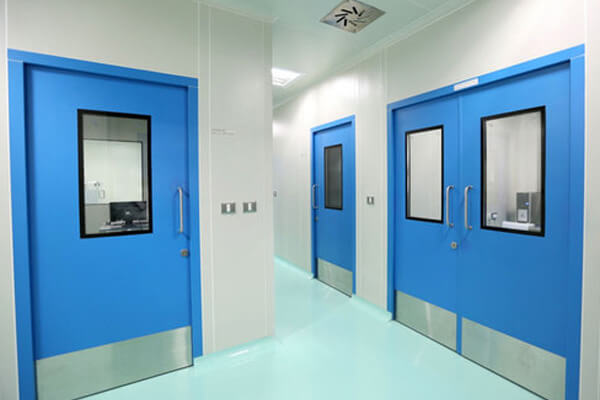

Choosing the Right Pharmaceutical Clean Room Door for GMP Standards: Key Factors to Consider
Choosing pharmaceutical doors starts with how each opening will be used. A personnel entrance, a trolley route and an equipment access point may need different door designs. Pharmaceutical clean room door should be evaluated for cleanability, leakage performance, traffic flow and compatibility with the facility’s contamination-control approach. This guide compares common door types, explains the project information needed for selection and provides a checklist to use when discussing requirements with a supplier.
Pharmaceutical doors are door systems used across drug-manufacturing and associated facilities. Pharmaceutical cleanroom doors are the subset selected for controlled environments, where the complete door assembly and its installation need to support the room’s intended operation. Selection involves the leaf or curtain, frame, seals, hardware, controls and wall interface.

Why are Clean Rooms Important to the Pharmaceutical Industry?
Precise environmental control
Cleanrooms are able to control temperature, humidity and airflow to ensure stability and consistency in the manufacturing process, which is essential for the production of high-precision medical devices.
Preventing Particulate Contamination
Clean rooms effectively filter and control particles, preventing them from entering the manufacturing process, thus ensuring product quality and safety.
Avoiding the spread of bacteria and pathogens
In the medical field, preventing the spread of bacteria and pathogens is critical. Clean rooms help reduce the risk of cross-infection by maintaining a highly hygienic environment.
Types of Pharmaceutical Doors Compared
Pharmaceutical doors are available in several operating designs, including swing, high-speed roll-up and sliding systems. The comparison below outlines their potential benefits, candidate applications and key points to verify. Zipper-guided doors are included as a subtype of high-speed roll-up doors.
Cleanroom Swing Doors
Cleanroom swing doors use hinged leaves and may be configured for manual or automatic operation. They are worth considering for personnel routes where predictable closing, accessible surfaces and coordination with access controls are priorities.
When reviewing a swing door, examine the leaf, frame, glazing, hinges and seals together. Stainless steel or coated steel construction should be assessed against the actual cleaning agents and service conditions; the material name alone does not establish cleanroom suitability.
Key selection considerations:
- Allow sufficient clearance for the leaf without obstructing people, trolleys or adjacent equipment.
- Check how the closing mechanism and seals perform under the intended pressure conditions.
- Confirm that exposed hardware, joints and glazing details can be cleaned effectively.
- Define any airlock interlock, access-control and emergency-operation requirements.
A swing door may suit a personnel entrance, but frequent trolley traffic can justify comparing alternative opening mechanisms before making a final selection.
High-Speed Roll-Up Doors
High-speed roll-up doors use a flexible curtain that travels vertically, avoiding the floor-level swing arc of a hinged leaf. They are candidates for routes with frequent movement of trolleys, materials or equipment.
A shorter opening cycle can help limit the time an opening remains exposed. However, the actual result also depends on traffic, activation settings, closing delays and the surrounding airflow design. Opening speed alone cannot demonstrate contamination control or pressure stability.
Compare cleanroom roll-up door configurations by their sealing details, accessible surfaces, curtain materials and control options. Within this category, distinguish zipper-guided designs from other guide arrangements.
Zipper-Guided High-Speed Doors
Zipper-guided doors retain the curtain edges within a compatible side-guide system. Some models also provide a self-reinsertion function that returns a displaced curtain to its guides during operation. SEPPES describes this feature on its zipper high-speed door product page.
For pharmaceutical applications, assess the guides and curtain as carefully as the opening mechanism. Ask for leakage results that identify the tested pressure difference, door dimensions and configuration.
Also confirm:
- Whether the curtain and seals tolerate the specified cleaning regime.
- How operators can access the guides and enclosure for cleaning.
- Which displacement conditions the reinsertion feature covers.
- Whether inspection or repair is required after an impact.
Curtain reinsertion should not be treated as proof of damage-free operation or as a substitute for personnel protection.
Cleanroom Sliding Doors
Sliding doors move laterally, which can help where a swing arc would interfere with an access route. They still require space for the door leaf to travel and for maintenance access.
For sterile pharmaceutical facilities, cleanability needs particular attention. EU GMP Annex 1, Section 4.6, advises avoiding door recesses that cannot be cleaned and notes that sliding doors may be undesirable for this reason. This calls for assessment of the actual design rather than assuming every sliding door is suitable or prohibited.
Before shortlisting a sliding door, review track access, concealed pockets, overlapping surfaces, floor guides and sealing details. Confirm that routine cleaning can reach the relevant areas and that the installation meets the project specification.
Selecting the Appropriate Door Type
Start with the opening’s purpose: personnel access, frequent material movement or occasional equipment transfer. Then compare the available space, traffic pattern, cleaning regime, leakage requirements and control functions.
The right pharmaceutical cleanroom door is the configuration that meets those documented requirements. Before requesting a quotation, prepare the clear opening dimensions, room use, pressure direction and cleaning conditions so the supplier can propose an assembly for meaningful technical review.
Pharmaceutical Door Types: Quick Comparison
|
Door type |
Selection benefit |
Candidate application |
What to verify |
|
Cleanroom swing door |
A rigid assembly that can provide accessible surfaces for routine cleaning |
Personnel entrances and airlock openings |
Swing clearance, seals, closing action, hardware, wall interface and access requirements |
|
Rapid access with a guided flexible curtain; some models offer curtain reinsertion after displacement |
Frequent trolley or material movements where the configuration is suitable |
Leakage test conditions, guide cleanability, curtain chemistry, sensor coverage and the limits of any self-repair feature |
|
|
Other high-speed roll-up door designs |
Flexible activation and opening arrangements for frequent traffic |
Internal logistics routes where cleanability and leakage requirements are demonstrated |
Exact guide and seal design; general industrial brush-guided doors should not be assumed suitable for critical cleanroom boundaries |
|
Cleanroom sliding door |
Avoids a swing arc and can accommodate certain access layouts |
Equipment or material openings with suitable side clearance |
Track and pocket access for cleaning, joints, sealing action and project acceptance; supply availability must be confirmed |
Door type alone does not establish cleanroom suitability. Compare the complete configuration against the project specification and supporting evidence before shortlisting a model.
Key Factors to Consider When Selecting Pharmaceutical Clean Room Door
Door Material and Durability
The material of the door is a key factor in the performance, durability and long-term cost of the clean room door. Common clean room door materials include stainless steel, aluminum and PVC. Different materials have different advantages and disadvantages in terms of durability, ease of cleaning and ability to comply with GMP standards.
Sealing and Air Tightness
A core requirement for pharmaceutical clean rooms is sealing and air tightness. These factors have a direct impact on the prevention of airborne contamination and the control of temperature and humidity. Clean room doors must have a good seal to ensure that the exchange of air between inside and outside is minimized, thus reducing the entry of outside contaminants. A high-quality sealing system protects against dust and insects and keeps the interior clean.
Ease of Cleaning and Maintenance
GMP standards require a high level of cleanliness and hygiene in clean rooms, and whether the door design is easy to clean and maintain is one of the key factors to consider when choosing. Clean room doors should be made of smooth surface materials to reduce the adhesion of dust and bacteria. The smoother the surface, the easier it is to clean and the more effective it is in avoiding bacterial growth. Also, the surface of pharmaceutical clean room doors should be designed to be as seamless as possible to avoid the accumulation of dust, microorganisms or other contaminants.
Door Opening Method and Suitability
The way a pharmaceutical clean room door opens has a direct impact on operational efficiency and environmental control. Common types of doors include high speed doors, steel swing doors, and self-repairing zipper doors. Each type of door has its own characteristics and application scenarios. When choosing the right type of door, you need to consider the space layout of the clean room, the frequency of people entering and exiting, as well as the operation process, to ensure that the type of clean room door you choose can meet the needs of production, and will not interfere with the clean environment.
GMP Considerations When Selecting Pharmaceutical Doors
Cleanroom Classification
Different cleanroom areas may have different environmental requirements. Where relevant, the facility’s ISO 14644 classification and applicable GMP cleanroom grades should be considered when selecting materials, sealing arrangements and door operation.
A door should not be marketed as universally suitable for a particular cleanroom grade without appropriate project-specific evidence.
Contamination Control Strategy
The door should support the site’s contamination control strategy, including personnel flow, material movement, cleaning procedures and separation of controlled areas.
For higher-risk processes, the opening arrangement may require additional controls beyond the door itself.
Airflow and Pressure Differentials
Door leakage, opening duration and traffic frequency can affect pressure-control performance. The facility’s HVAC designer should confirm whether the proposed door meets the project’s pressure and airflow assumptions.
Cleaning and Disinfection Compatibility
Door materials, seals and exposed components should tolerate the site’s approved cleaning and disinfection procedures. Chemical compatibility should be confirmed with the manufacturer, especially where strong or repeated disinfectant exposure is expected.
Documentation and Qualification
For regulated pharmaceutical projects, buyers may require technical drawings, material specifications, operation manuals, maintenance instructions or performance documentation. Where applicable, door installation and operation may also form part of the facility’s qualification and verification activities.
GMP suitability is determined by the application, documented design, installation and verification—not by a general product label alone.
Pharmaceutical Clean Room Door Options: High Speed Door vs Zipper Door vs Steel Swing Doors
High Speed Clean Room Doors
Rapid doors, such as high-speed roll-up doors, are very popular in modern clean rooms, especially in environments that require frequent entry and exit. Designed to open and close quickly, these doors minimize environmental contamination and ensure airtightness and stable temperature and humidity in the clean room.
Advantages
Rapid opening and closing: High speed clean room door opening speed is very fast, can improve the efficiency of entry and exit. Especially suitable for high-frequency entry and exit of the clean room environment.
Energy saving: Fast door can reduce the temperature fluctuation caused by opening the door, reduce the loss of cold air or hot air, thus saving energy consumption.
Reduce air pollution: Fast opening and closing doors can effectively reduce air pollutants into the clean room, to maintain the stability of the clean environment.
Disadvantages
Sealing limitation: The rapid door track adopts double-row brush type structure. The sealing is not as good as the zipper structure. Although it is suitable for high-frequency in and out of the environment. But used in the pharmaceutical clean room, its sealing may not be as good as other types of doors.

Zipper Clean Room Doors
Zipper clean room doors are widely used in large-area clean rooms for their unique design and function. The door frame and header box are made of stainless steel as standard. And the door curtain is made of 2.5mm thickened curtain. Through the special sealing strip and unique zipper system. It is more airtight and dustproof, constant temperature and moisturizing than ordinary door. It can reach the use standard of pharmaceutical GMP workshop.
Advantage
Adaptable: Zipper door can be flexibly adjusted according to the actual demand. Especially suitable for areas that need frequent opening and closing.
Strong sealing: Due to the unique sealing design, the sealing performance of the zipper door is superior. It can effectively prevent external contaminants from entering the cleanroom.
Good anti-pollution: High speed zipper door usually has strong anti-pollution ability, can effectively reduce the breeding of bacteria and microorganisms.
Disadvantages
Not as airtight as steel doors: In some cases, self-reapiring zipper doors are not as airtight as steel doors, which may affect cleanroom air quality control. Especially in demanding pharmaceutical environments.

Steel Clean Room Doors
Steel swing doors are a traditional door type, usually made of stainless steel or carbon steel. They are robust and widely used in environments where high durability and strong sealing properties are required.
Advantages
High strength and durability: Steel clean room doors have very high durability. It can withstand high frequency of opening and closing as well as harsh environments, making them suitable for long term use.
Easy to clean and maintain: Steel doors have a smooth surface that is easy to clean and meets the strict requirements of GMP standards for cleanrooms.
Disadvantages
Heavy: Steel doors are relatively heavy, requiring additional support structures for installation. And opening and closing the door may be laborious.
Takes up more space: Steel clean room doors take up more space for installation and maintenance, and are suitable for clean rooms with plenty of space.
How to Choose the Right Pharmaceutical Door
Step 1: Identify the Application
Determine whether the door is intended for:
-
Personnel access.
-
Material transfer.
-
Equipment movement.
-
A cleanroom airlock.
-
A packaging or supporting production area.
Different traffic patterns may lead to different door selections.
Step 2: Confirm Environmental Requirements
Review the cleanroom classification, pressure-control strategy, cleaning procedures and relevant GMP requirements. Establish whether specific air leakage, material or operating performance must be documented.
Step 3: Evaluate Traffic Frequency
High-traffic entrances may benefit from automated high-speed doors, while less frequently used personnel entrances may be better served by swing doors.
Consider peak traffic rather than only average daily usage.
Step 4: Measure the Opening and Installation Space
Confirm the clear opening width and height, available headroom, side clearance and structural installation conditions.
Door selection should also consider nearby equipment, ceilings and utilities.
Step 5: Specify Materials and Controls
Choose appropriate frame and curtain or panel materials.
Identify required activation methods, access controls, interlocking functions and safety devices.
Step 6: Review Supplier Documentation
Request drawings, configuration details, relevant performance information and maintenance instructions.
Where the project requires verified sealing or other specific performance, the supplier should provide suitable evidence or agree on a project-specific verification method.
FAQs
What types of doors are used in pharmaceutical cleanrooms?
Common pharmaceutical cleanroom doors include high-speed zipper doors, PVC roll-up doors, rigid swing doors and sliding doors. High-speed doors are often considered for frequently used material passages, while swing doors are suitable for controlled personnel entrances. Selection depends on traffic, hygiene, sealing and facility requirements.
Can pharmaceutical cleanroom doors support interlocking systems?
Yes. Suitable door controllers can be integrated into interlocking arrangements to coordinate access between adjacent rooms or airlocks. The configuration must account for operational needs, personnel safety and emergency release requirements.
Are high-speed doors suitable for GMP cleanrooms?
High-speed doors can be suitable for certain GMP cleanroom applications when their design, materials, sealing performance and controls meet the project’s documented requirements. Suitability must be evaluated as part of the overall facility design and contamination control strategy.
What materials are commonly used for pharmaceutical doors?
Pharmaceutical doors may use stainless steel, coated steel, rigid hygienic panels or flexible PVC curtains. Stainless steel is often selected for its cleanability and corrosion resistance, while PVC curtains are commonly used in high-speed systems. Material selection should account for cleaning chemicals and exposure conditions.
When choosing GMP pharmaceutical clean room door, different types of doors have different advantages and disadvantages. Understanding the characteristics of each type of door and choosing one that meets the actual needs of your clean room will help you ensure product quality, improve productivity and reduce maintenance costs. SEPPES is exported to more than 70 of the world’s top 500 companies, such as IKEA, AkzoNobel, Fresenius and others.

