
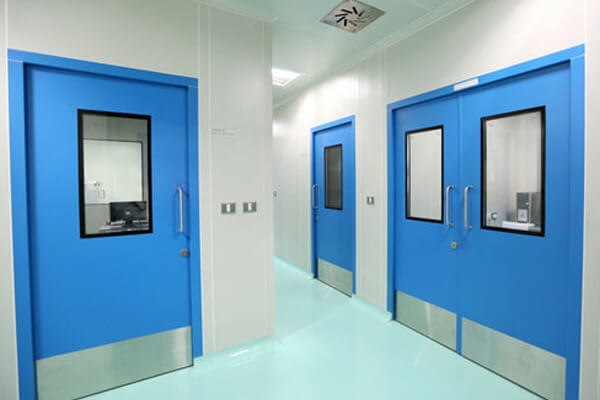

Selección de la puerta adecuada para sala limpia farmacéutica según normas GMP: Factores clave a considerar.
Choosing pharmaceutical doors starts with how each opening will be used. A personnel entrance, a trolley route and an equipment access point may need different door designs. Pharmaceutical clean room door should be evaluated for cleanability, leakage performance, traffic flow and compatibility with the facility’s contamination-control approach. This guide compares common door types, explains the project information needed for selection and provides a checklist to use when discussing requirements with a supplier.
Pharmaceutical doors are door systems used across drug-manufacturing and associated facilities. Pharmaceutical cleanroom doors are the subset selected for controlled environments, where the complete door assembly and its installation need to support the room’s intended operation. Selection involves the leaf or curtain, frame, seals, hardware, controls and wall interface.

为什么洁净室对制药行业如此重要?
精确的环境控制
洁净室能够控制温度、湿度和气流,以确保制造过程中的稳定性和一致性,这对于高精度医疗器械的生产至关重要。.
防止颗粒污染
洁净室有效过滤和控制颗粒物,防止其进入制造过程,从而确保产品质量和安全性。.
避免细菌和病原体的传播
在医疗领域,防止细菌和病原体的传播至关重要。洁净室通过维持高度卫生的环境,有助于降低交叉感染的风险。.
Types of Pharmaceutical Doors Compared
Pharmaceutical doors are available in several operating designs, including swing, high-speed roll-up and sliding systems. The comparison below outlines their potential benefits, candidate applications and key points to verify. Zipper-guided doors are included as a subtype of high-speed roll-up doors.
Cleanroom Swing Doors
Cleanroom swing doors use hinged leaves and may be configured for manual or automatic operation. They are worth considering for personnel routes where predictable closing, accessible surfaces and coordination with access controls are priorities.
When reviewing a swing door, examine the leaf, frame, glazing, hinges and seals together. Stainless steel or coated steel construction should be assessed against the actual cleaning agents and service conditions; the material name alone does not establish cleanroom suitability.
Key selection considerations:
- Allow sufficient clearance for the leaf without obstructing people, trolleys or adjacent equipment.
- Check how the closing mechanism and seals perform under the intended pressure conditions.
- Confirm that exposed hardware, joints and glazing details can be cleaned effectively.
- Define any airlock interlock, access-control and emergency-operation requirements.
A swing door may suit a personnel entrance, but frequent trolley traffic can justify comparing alternative opening mechanisms before making a final selection.
Puertas enrollables de alta velocidad
High-speed roll-up doors use a flexible curtain that travels vertically, avoiding the floor-level swing arc of a hinged leaf. They are candidates for routes with frequent movement of trolleys, materials or equipment.
A shorter opening cycle can help limit the time an opening remains exposed. However, the actual result also depends on traffic, activation settings, closing delays and the surrounding airflow design. Opening speed alone cannot demonstrate contamination control or pressure stability.
Compare cleanroom roll-up door configurations by their sealing details, accessible surfaces, curtain materials and control options. Within this category, distinguish zipper-guided designs from other guide arrangements.
Zipper-Guided High-Speed Doors
Zipper-guided doors retain the curtain edges within a compatible side-guide system. Some models also provide a self-reinsertion function that returns a displaced curtain to its guides during operation. SEPPES describes this feature on its zipper high-speed door product page.
For pharmaceutical applications, assess the guides and curtain as carefully as the opening mechanism. Ask for leakage results that identify the tested pressure difference, door dimensions and configuration.
Also confirm:
- Whether the curtain and seals tolerate the specified cleaning regime.
- How operators can access the guides and enclosure for cleaning.
- Which displacement conditions the reinsertion feature covers.
- Whether inspection or repair is required after an impact.
Curtain reinsertion should not be treated as proof of damage-free operation or as a substitute for personnel protection.
Puertas Correderas para Salas Limpias
Sliding doors move laterally, which can help where a swing arc would interfere with an access route. They still require space for the door leaf to travel and for maintenance access.
For sterile pharmaceutical facilities, cleanability needs particular attention. EU GMP Annex 1, Section 4.6, advises avoiding door recesses that cannot be cleaned and notes that sliding doors may be undesirable for this reason. This calls for assessment of the actual design rather than assuming every sliding door is suitable or prohibited.
Before shortlisting a sliding door, review track access, concealed pockets, overlapping surfaces, floor guides and sealing details. Confirm that routine cleaning can reach the relevant areas and that the installation meets the project specification.
Selecting the Appropriate Door Type
Start with the opening’s purpose: personnel access, frequent material movement or occasional equipment transfer. Then compare the available space, traffic pattern, cleaning regime, leakage requirements and control functions.
The right pharmaceutical cleanroom door is the configuration that meets those documented requirements. Before requesting a quotation, prepare the clear opening dimensions, room use, pressure direction and cleaning conditions so the supplier can propose an assembly for meaningful technical review.
Pharmaceutical Door Types: Quick Comparison
|
Door type |
Selection benefit |
Candidate application |
What to verify |
|
Cleanroom swing door |
A rigid assembly that can provide accessible surfaces for routine cleaning |
Personnel entrances and airlock openings |
Swing clearance, seals, closing action, hardware, wall interface and access requirements |
|
Rapid access with a guided flexible curtain; some models offer curtain reinsertion after displacement |
Frequent trolley or material movements where the configuration is suitable |
Leakage test conditions, guide cleanability, curtain chemistry, sensor coverage and the limits of any self-repair feature |
|
|
Other high-speed roll-up door designs |
Flexible activation and opening arrangements for frequent traffic |
Internal logistics routes where cleanability and leakage requirements are demonstrated |
Exact guide and seal design; general industrial brush-guided doors should not be assumed suitable for critical cleanroom boundaries |
|
Cleanroom sliding door |
Avoids a swing arc and can accommodate certain access layouts |
Equipment or material openings with suitable side clearance |
Track and pocket access for cleaning, joints, sealing action and project acceptance; supply availability must be confirmed |
Door type alone does not establish cleanroom suitability. Compare the complete configuration against the project specification and supporting evidence before shortlisting a model.
选择制药洁净室门时需要考虑的关键因素
门体材料与耐久性
门体材料是影响洁净室门性能、耐久性和长期成本的关键因素。常见的洁净室门材料包括不锈钢、铝材和PVC。不同材料在耐久性、清洁便利性以及是否符合GMP标准方面各有优缺点。.
密封性与气密性
制药洁净室的核心要求之一是密封性和气密性。这些因素直接影响对空气传播污染的防护以及温度和湿度的控制。洁净室门必须具备良好的密封性能,以确保内外空气交换最小化,从而减少外部污染物的进入。高质量的密封系统能够防尘防虫,并保持内部环境的洁净。.
清洁与维护的便利性
GMP标准要求洁净室保持高水平的清洁和卫生,门体设计是否易于清洁和维护是选择时需要考虑的关键因素之一。洁净室门应采用表面光滑的材料,以减少灰尘和细菌的附着。表面越光滑,越容易清洁,也越能有效避免细菌滋生。此外,制药洁净室门的表面应尽可能设计为无缝结构,以避免灰尘、微生物或其他污染物的积聚。.
开门方式与适用性
制药洁净室门的开启方式直接影响运行效率和环境控制。常见的门型包括 puertas rápidas, 钢制平开门, y puertas de cremallera autorreparables. 。每种门型都有其自身的特点和应用场景。在选择合适的门型时,需要考虑洁净室的空间布局、人员进出频率以及操作流程,以确保所选择的 洁净室门类型 能够满足生产需求,同时不会干扰洁净环境。.
GMP Considerations When Selecting Pharmaceutical Doors
Cleanroom Classification
Different cleanroom areas may have different environmental requirements. Where relevant, the facility’s ISO 14644 classification and applicable GMP cleanroom grades should be considered when selecting materials, sealing arrangements and door operation.
A door should not be marketed as universally suitable for a particular cleanroom grade without appropriate project-specific evidence.
Contamination Control Strategy
The door should support the site’s contamination control strategy, including personnel flow, material movement, cleaning procedures and separation of controlled areas.
For higher-risk processes, the opening arrangement may require additional controls beyond the door itself.
Airflow and Pressure Differentials
Door leakage, opening duration and traffic frequency can affect pressure-control performance. The facility’s HVAC designer should confirm whether the proposed door meets the project’s pressure and airflow assumptions.
Cleaning and Disinfection Compatibility
Door materials, seals and exposed components should tolerate the site’s approved cleaning and disinfection procedures. Chemical compatibility should be confirmed with the manufacturer, especially where strong or repeated disinfectant exposure is expected.
Documentation and Qualification
For regulated pharmaceutical projects, buyers may require technical drawings, material specifications, operation manuals, maintenance instructions or performance documentation. Where applicable, door installation and operation may also form part of the facility’s qualification and verification activities.
GMP suitability is determined by the application, documented design, installation and verification—not by a general product label alone.
制药洁净室门选项:高速门 vs 拉链门 vs 钢制平开门
高速洁净室门
快速门,例如高速卷帘门,在现代洁净室中非常受欢迎,尤其是在需要频繁进出的环境中。这类门设计为快速开启和关闭,能够最大限度地减少环境污染,并确保洁净室的气密性以及温度和湿度的稳定。.
Ventajas
快速开启与关闭优点——高效通行:高速洁净室门的开启速度非常快,能够提高进出效率。特别适用于高频进出的洁净室环境。.
节能效果优点——节能:快速门能够减少开门引起的温度波动,降低冷气或热气的损失,从而节约能源消耗。.
优点——减少空气污染:快速开启和关闭的门能够有效减少空气污染物进入洁净室,维持洁净环境的稳定性。缺点——密封性限制:快速门的轨道采用双排毛刷式结构,其密封性不如拉链结构。虽然适用于高频进出的环境,但在制药洁净室中使用时,其密封性能可能不如其他类型的门。.
Desventajas
拉链式洁净室门拉链式洁净室门凭借其独特的设计和功能,广泛应用于大面积洁净室。门框和顶部箱体标配采用不锈钢材质。门帘采用2.5mm加厚帘布。通过特殊的密封条和独特的拉链系统,其气密性、防尘性、恒温保湿性能优于普通门,可达到制药GMP车间的使用标准。.

优点——适应性强:拉链门可根据实际需求灵活调整,特别适用于需要频繁开启和关闭的区域。
优点——密封性强:由于独特的密封设计,拉链门的密封性能优越,能够有效防止外部污染物进入洁净室。.
优点——抗污染性好:高速拉链门通常具有较强的抗污染能力,能够有效减少细菌和微生物的滋生。
缺点——气密性不如钢制门:在某些情况下,自修复拉链门的气密性不如钢制门,这可能会影响洁净室的空气质量控控制,尤其是在要求严格的制药环境中。钢制洁净室门.
钢制平开门是一种传统的门型,通常采用不锈钢或碳钢制成。其结构坚固,广泛应用于需要高耐久性和强密封性能的环境中。优点——高强度和高耐久性:钢制洁净室门具有非常高的耐久性,能够承受高频次的开关操作以及恶劣环境,适合长期使用。.
Good anti-pollution: High speed zipper door usually has strong anti-pollution ability, can effectively reduce the breeding of bacteria and microorganisms.
Desventajas
Not as airtight as steel doors: In some cases, self-reapiring zipper doors are not as airtight as steel doors, which may affect cleanroom air quality control. Especially in demanding pharmaceutical environments.

Steel Clean Room Doors
Steel swing doors are a traditional door type, usually made of stainless steel or carbon steel. They are robust and widely used in environments where high durability and strong sealing properties are required.
Ventajas
High strength and durability: Steel clean room doors have very high durability. It can withstand high frequency of opening and closing as well as harsh environments, making them suitable for long term use.
Fácil de limpiar y mantener: Las puertas de acero tienen una superficie lisa que es fácil de limpiar y cumple con los estrictos requisitos de las normas GMP para salas limpias.
Desventajas
Pesada: Las puertas de acero son relativamente pesadas, lo que requiere estructuras de soporte adicionales para su instalación. Además, abrir y cerrar la puerta puede resultar laborioso.
Ocupa más espacio: Las puertas de acero para salas limpias ocupan más espacio para su instalación y mantenimiento, y son adecuadas para salas limpias con espacio amplio.
How to Choose the Right Pharmaceutical Door
Step 1: Identify the Application
Determine whether the door is intended for:
-
Personnel access.
-
Material transfer.
-
Equipment movement.
-
A cleanroom airlock.
-
A packaging or supporting production area.
Different traffic patterns may lead to different door selections.
Step 2: Confirm Environmental Requirements
Review the cleanroom classification, pressure-control strategy, cleaning procedures and relevant GMP requirements. Establish whether specific air leakage, material or operating performance must be documented.
Step 3: Evaluate Traffic Frequency
High-traffic entrances may benefit from automated high-speed doors, while less frequently used personnel entrances may be better served by swing doors.
Consider peak traffic rather than only average daily usage.
Step 4: Measure the Opening and Installation Space
Confirm the clear opening width and height, available headroom, side clearance and structural installation conditions.
Door selection should also consider nearby equipment, ceilings and utilities.
Step 5: Specify Materials and Controls
Choose appropriate frame and curtain or panel materials.
Identify required activation methods, access controls, interlocking functions and safety devices.
Step 6: Review Supplier Documentation
Request drawings, configuration details, relevant performance information and maintenance instructions.
Where the project requires verified sealing or other specific performance, the supplier should provide suitable evidence or agree on a project-specific verification method.
Preguntas frecuentes
What types of doors are used in pharmaceutical cleanrooms?
Common pharmaceutical cleanroom doors include high-speed zipper doors, PVC roll-up doors, rigid swing doors and sliding doors. High-speed doors are often considered for frequently used material passages, while swing doors are suitable for controlled personnel entrances. Selection depends on traffic, hygiene, sealing and facility requirements.
Can pharmaceutical cleanroom doors support interlocking systems?
Yes. Suitable door controllers can be integrated into interlocking arrangements to coordinate access between adjacent rooms or airlocks. The configuration must account for operational needs, personnel safety and emergency release requirements.
Are high-speed doors suitable for GMP cleanrooms?
High-speed doors can be suitable for certain GMP cleanroom applications when their design, materials, sealing performance and controls meet the project’s documented requirements. Suitability must be evaluated as part of the overall facility design and contamination control strategy.
What materials are commonly used for pharmaceutical doors?
Pharmaceutical doors may use stainless steel, coated steel, rigid hygienic panels or flexible PVC curtains. Stainless steel is often selected for its cleanability and corrosion resistance, while PVC curtains are commonly used in high-speed systems. Material selection should account for cleaning chemicals and exposure conditions.
Al elegir una puerta para sala limpia farmacéutica GMP, los diferentes tipos de puertas presentan distintas ventajas y desventajas. Comprender las características de cada tipo de puerta y seleccionar una que se ajuste a las necesidades reales de su sala limpia le ayudará a garantizar la calidad del producto, mejorar la productividad y reducir los costos de mantenimiento. SEPPES exporta a más de 70 de las empresas Fortune 500 del mundo, como IKEA, AkzoNobel, Fresenius y otras.

