
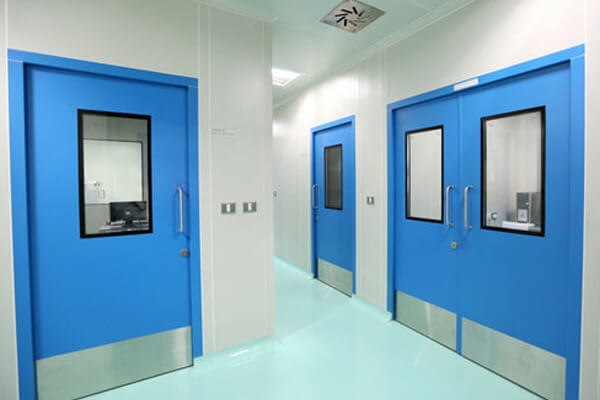

GMP基準に適合する医薬品クリーンルーム用ドアの選び方:考慮すべき主要因子
Choosing pharmaceutical doors starts with how each opening will be used. A personnel entrance, a trolley route and an equipment access point may need different door designs. Pharmaceutical clean room door should be evaluated for cleanability, leakage performance, traffic flow and compatibility with the facility’s contamination-control approach. This guide compares common door types, explains the project information needed for selection and provides a checklist to use when discussing requirements with a supplier.
Pharmaceutical doors are door systems used across drug-manufacturing and associated facilities. Pharmaceutical cleanroom doors are the subset selected for controlled environments, where the complete door assembly and its installation need to support the room’s intended operation. Selection involves the leaf or curtain, frame, seals, hardware, controls and wall interface.

クリーンルームが医薬品業界にとって重要な理由
精密な環境制御
クリーンルームは温度、湿度、気流を制御し、製造工程の安定性と一貫性を確保することができる。これは高精度医療機器の製造に不可欠である。.
粒子汚染の防止
クリーンルームは粒子を効果的に濾過・制御し、製造工程への侵入を防ぐことで、製品品質と安全性を確保する。.
細菌および病原体の拡散防止
医療分野において、細菌および病原体の拡散防止は極めて重要である。クリーンルームは高度な衛生環境を維持することで、交差感染のリスクを低減するのに役立つ。.
Types of Pharmaceutical Doors Compared
Pharmaceutical doors are available in several operating designs, including swing, high-speed roll-up and sliding systems. The comparison below outlines their potential benefits, candidate applications and key points to verify. Zipper-guided doors are included as a subtype of high-speed roll-up doors.
Cleanroom Swing Doors
Cleanroom swing doors use hinged leaves and may be configured for manual or automatic operation. They are worth considering for personnel routes where predictable closing, accessible surfaces and coordination with access controls are priorities.
When reviewing a swing door, examine the leaf, frame, glazing, hinges and seals together. Stainless steel or coated steel construction should be assessed against the actual cleaning agents and service conditions; the material name alone does not establish cleanroom suitability.
Key selection considerations:
- Allow sufficient clearance for the leaf without obstructing people, trolleys or adjacent equipment.
- Check how the closing mechanism and seals perform under the intended pressure conditions.
- Confirm that exposed hardware, joints and glazing details can be cleaned effectively.
- Define any airlock interlock, access-control and emergency-operation requirements.
A swing door may suit a personnel entrance, but frequent trolley traffic can justify comparing alternative opening mechanisms before making a final selection.
高速ロールアップドア
High-speed roll-up doors use a flexible curtain that travels vertically, avoiding the floor-level swing arc of a hinged leaf. They are candidates for routes with frequent movement of trolleys, materials or equipment.
A shorter opening cycle can help limit the time an opening remains exposed. However, the actual result also depends on traffic, activation settings, closing delays and the surrounding airflow design. Opening speed alone cannot demonstrate contamination control or pressure stability.
Compare cleanroom roll-up door configurations by their sealing details, accessible surfaces, curtain materials and control options. Within this category, distinguish zipper-guided designs from other guide arrangements.
Zipper-Guided High-Speed Doors
Zipper-guided doors retain the curtain edges within a compatible side-guide system. Some models also provide a self-reinsertion function that returns a displaced curtain to its guides during operation. SEPPES describes this feature on its zipper high-speed door product page.
For pharmaceutical applications, assess the guides and curtain as carefully as the opening mechanism. Ask for leakage results that identify the tested pressure difference, door dimensions and configuration.
Also confirm:
- Whether the curtain and seals tolerate the specified cleaning regime.
- How operators can access the guides and enclosure for cleaning.
- Which displacement conditions the reinsertion feature covers.
- Whether inspection or repair is required after an impact.
Curtain reinsertion should not be treated as proof of damage-free operation or as a substitute for personnel protection.
適切なドアタイプの選択は、施設のレイアウトと必要な清浄度グレードのバランスです。両方の構成に利点はありますが、管理された環境の厳格な要求の下では、異なる性能を発揮します。
Sliding doors move laterally, which can help where a swing arc would interfere with an access route. They still require space for the door leaf to travel and for maintenance access.
For sterile pharmaceutical facilities, cleanability needs particular attention. EU GMP Annex 1, Section 4.6, advises avoiding door recesses that cannot be cleaned and notes that sliding doors may be undesirable for this reason. This calls for assessment of the actual design rather than assuming every sliding door is suitable or prohibited.
Before shortlisting a sliding door, review track access, concealed pockets, overlapping surfaces, floor guides and sealing details. Confirm that routine cleaning can reach the relevant areas and that the installation meets the project specification.
Selecting the Appropriate Door Type
Start with the opening’s purpose: personnel access, frequent material movement or occasional equipment transfer. Then compare the available space, traffic pattern, cleaning regime, leakage requirements and control functions.
The right pharmaceutical cleanroom door is the configuration that meets those documented requirements. Before requesting a quotation, prepare the clear opening dimensions, room use, pressure direction and cleaning conditions so the supplier can propose an assembly for meaningful technical review.
Pharmaceutical Door Types: Quick Comparison
|
Door type |
Selection benefit |
Candidate application |
What to verify |
|
Cleanroom swing door |
A rigid assembly that can provide accessible surfaces for routine cleaning |
Personnel entrances and airlock openings |
Swing clearance, seals, closing action, hardware, wall interface and access requirements |
|
Rapid access with a guided flexible curtain; some models offer curtain reinsertion after displacement |
Frequent trolley or material movements where the configuration is suitable |
Leakage test conditions, guide cleanability, curtain chemistry, sensor coverage and the limits of any self-repair feature |
|
|
Other high-speed roll-up door designs |
Flexible activation and opening arrangements for frequent traffic |
Internal logistics routes where cleanability and leakage requirements are demonstrated |
Exact guide and seal design; general industrial brush-guided doors should not be assumed suitable for critical cleanroom boundaries |
|
Cleanroom sliding door |
Avoids a swing arc and can accommodate certain access layouts |
Equipment or material openings with suitable side clearance |
Track and pocket access for cleaning, joints, sealing action and project acceptance; supply availability must be confirmed |
Door type alone does not establish cleanroom suitability. Compare the complete configuration against the project specification and supporting evidence before shortlisting a model.
医薬品クリーンルーム用ドア選定時に考慮すべき主要因子
ドア材質と耐久性
ドアの材質は、クリーンルーム用ドアの性能、耐久性、長期的なコストに影響を与える主要因子である。一般的なクリーンルーム用ドアの材質には、ステンレス鋼、アルミニウム、PVCがある。各材質は、耐久性、洗浄の容易さ、GMP基準への適合性において、それぞれ長所と短所を有する。.
シーリングと気密性
医薬品クリーンルームの中核的要件は、シーリングと気密性である。これらの因子は、空気由来汚染の防止、温度・湿度管理に直接的な影響を与える。クリーンルーム用ドアは、内外の空気交換を最小限に抑え、外部からの汚染物質の侵入を低減するため、優れたシール性を備えていなければならない。高品質なシーリングシステムは、塵埃や虫の侵入を防ぎ、内部の清浄度を維持する。.
洗浄およびメンテナンスの容易性
GMP基準では、クリーンルーム内の高度な清浄度と衛生状態が要求され、ドア設計が洗浄・メンテナンスしやすいかどうかは、選定時に考慮すべき主要因子の一つである。クリーンルーム用ドアは、塵埃や細菌の付着を低減するため、平滑な表面材質で作られるべきである。表面が平滑であるほど洗浄が容易であり、細菌の繁殖防止に効果的である。また、医薬品クリーンルーム用ドアの表面は、塵埃、微生物、その他の汚染物質の蓄積を避けるため、可能な限りシームレスに設計されるべきである。.
ドアの開閉方式と適合性
医薬品クリーンルーム用ドアの開閉方式は、運用効率と環境制御に直接的な影響を与える。一般的なドアタイプには 高速ドア, スチールスイングドア, 、および 自己修復ジッパードア. がある。各ドアタイプは独自の特性と適用シナリオを有する。適切なドアタイプを選定する際には、クリーンルームの空間レイアウト、人の出入り頻度、運用プロセスを考慮し、選択した クリーンルーム用ドアのタイプ が生産ニーズを満たし、かつクリーン環境を妨げないことを確保する必要がある。.
GMP Considerations When Selecting Pharmaceutical Doors
Cleanroom Classification
Different cleanroom areas may have different environmental requirements. Where relevant, the facility’s ISO 14644 classification and applicable GMP cleanroom grades should be considered when selecting materials, sealing arrangements and door operation.
A door should not be marketed as universally suitable for a particular cleanroom grade without appropriate project-specific evidence.
Contamination Control Strategy
The door should support the site’s contamination control strategy, including personnel flow, material movement, cleaning procedures and separation of controlled areas.
For higher-risk processes, the opening arrangement may require additional controls beyond the door itself.
Airflow and Pressure Differentials
Door leakage, opening duration and traffic frequency can affect pressure-control performance. The facility’s HVAC designer should confirm whether the proposed door meets the project’s pressure and airflow assumptions.
Cleaning and Disinfection Compatibility
Door materials, seals and exposed components should tolerate the site’s approved cleaning and disinfection procedures. Chemical compatibility should be confirmed with the manufacturer, especially where strong or repeated disinfectant exposure is expected.
Documentation and Qualification
For regulated pharmaceutical projects, buyers may require technical drawings, material specifications, operation manuals, maintenance instructions or performance documentation. Where applicable, door installation and operation may also form part of the facility’s qualification and verification activities.
GMP suitability is determined by the application, documented design, installation and verification—not by a general product label alone.
医薬品クリーンルーム用ドアの選択肢:高速ドア vs ジッパードア vs スチールスイングドア
高速クリーンルーム用ドア
高速ドア(高速ロールアップドアなど)は、現代のクリーンルーム、特に頻繁な出入りが必要な環境で非常に普及している。これらのドアは迅速な開閉を目的として設計されており、環境汚染を最小限に抑え、クリーンルームの気密性と温度・湿度の安定性を確保する。.
利点
高速ドアは、迅速な動きと効率性を必要とする施設に優れた選択肢です。これらのドアは、素早く開閉するように設計されており、管理された環境を維持し、生産性を向上させるのに役立ちます。利点:高速クリーンルーム用ドアの開閉速度は非常に速く、出入りの効率を向上させることができる。特に出入り頻度の高いクリーンルーム環境に適している。.
省エネルギーエネルギー節約:高速ドアはドア開放による温度変動を低減し、冷気または暖気の損失を抑えることで、エネルギー消費を節約できる。.
空気汚染の低減:高速開閉ドアは、クリーンルームへの空気汚染物質の侵入を効果的に低減し、クリーン環境の安定性を維持できる。シーリングの限界:高速ドアのレールは二列ブラシ構造を採用している。シーリング性能はジッパー構造ほど優れていない。高頻度の出入り環境には適しているが、医薬品クリーンルームで使用する場合、そのシーリング性能は他のタイプのドアに及ばない可能性がある。.
デメリット
ジッパークリーンルーム用ドアジッパークリーンルーム用ドアは、その独自の設計と機能により、大面積のクリーンルームで広く使用されている。ドアフレームとヘッダーボックスは標準でステンレス鋼製である。ドアカーテンは2.5mm厚の強化カーテンで作られている。特殊なシーリングストリップと独自のジッパーシステムにより、通常のドアよりも気密性、防塵性、恒温・保湿性に優れている。医薬品GMP工場の使用基準に達することができる。.

利点
適応性:ジッパードアは実際の需要に応じて柔軟に調整できる。特に頻繁な開閉が必要なエリアに適している。.
強力なシーリング:独自のシーリング設計により、ジッパードアのシーリング性能は優れている。外部からの汚染物質のクリーンルームへの侵入を効果的に防止できる。
優れた防汚性:高速ジッパードアは通常、強力な防汚能力を有し、細菌や微生物の繁殖を効果的に低減できる。制限:スチールドアほどの気密性はない:場合によっては、.
自己修復式ジッパードアはスチールドアほどの気密性を有さず、クリーンルームの空気品質管理に影響を与える可能性がある。特に要求の厳しい医薬品環境において顕著である。.
スチールクリーンルーム用ドアスチールスイングドアは伝統的なドアタイプであり、通常ステンレス鋼または炭素鋼で製造される。堅牢であり、高い耐久性と強力なシーリング特性が要求される環境で広く使用されている。.
デメリット
高強度と耐久性:スチールクリーンルーム用ドアは非常に高い耐久性を有する。高頻度の開閉や過酷な環境に耐えることができ、長期的な使用に適している。 In some cases, self-reapiring zipper doors are not as airtight as steel doors, which may affect cleanroom air quality control. Especially in demanding pharmaceutical environments.

Steel Clean Room Doors
Steel swing doors are a traditional door type, usually made of stainless steel or carbon steel. They are robust and widely used in environments where high durability and strong sealing properties are required.
利点
High strength and durability: Steel clean room doors have very high durability. It can withstand high frequency of opening and closing as well as harsh environments, making them suitable for long term use.
清掃とメンテナンスが容易:スチールドアは表面が滑らかで清掃が容易であり、クリーンルームに関するGMP基準の厳格な要件を満たしています。.
デメリット
重量が大きい:スチールドアは比較的重量があり、設置には追加の支持構造が必要です。また、ドアの開閉に労力を要する場合があります。.
占有スペースが大きい:スチール製クリーンルームドアは、設置およびメンテナンスに多くのスペースを必要とし、十分なスペースがあるクリーンルームに適しています。.
How to Choose the Right Pharmaceutical Door
Step 1: Identify the Application
Determine whether the door is intended for:
-
Personnel access.
-
Material transfer.
-
Equipment movement.
-
A cleanroom airlock.
-
A packaging or supporting production area.
Different traffic patterns may lead to different door selections.
Step 2: Confirm Environmental Requirements
Review the cleanroom classification, pressure-control strategy, cleaning procedures and relevant GMP requirements. Establish whether specific air leakage, material or operating performance must be documented.
Step 3: Evaluate Traffic Frequency
High-traffic entrances may benefit from automated high-speed doors, while less frequently used personnel entrances may be better served by swing doors.
Consider peak traffic rather than only average daily usage.
Step 4: Measure the Opening and Installation Space
Confirm the clear opening width and height, available headroom, side clearance and structural installation conditions.
Door selection should also consider nearby equipment, ceilings and utilities.
Step 5: Specify Materials and Controls
Choose appropriate frame and curtain or panel materials.
Identify required activation methods, access controls, interlocking functions and safety devices.
Step 6: Review Supplier Documentation
Request drawings, configuration details, relevant performance information and maintenance instructions.
Where the project requires verified sealing or other specific performance, the supplier should provide suitable evidence or agree on a project-specific verification method.
よくある質問(FAQ)
What types of doors are used in pharmaceutical cleanrooms?
Common pharmaceutical cleanroom doors include high-speed zipper doors, PVC roll-up doors, rigid swing doors and sliding doors. High-speed doors are often considered for frequently used material passages, while swing doors are suitable for controlled personnel entrances. Selection depends on traffic, hygiene, sealing and facility requirements.
Can pharmaceutical cleanroom doors support interlocking systems?
Yes. Suitable door controllers can be integrated into interlocking arrangements to coordinate access between adjacent rooms or airlocks. The configuration must account for operational needs, personnel safety and emergency release requirements.
Are high-speed doors suitable for GMP cleanrooms?
High-speed doors can be suitable for certain GMP cleanroom applications when their design, materials, sealing performance and controls meet the project’s documented requirements. Suitability must be evaluated as part of the overall facility design and contamination control strategy.
What materials are commonly used for pharmaceutical doors?
Pharmaceutical doors may use stainless steel, coated steel, rigid hygienic panels or flexible PVC curtains. Stainless steel is often selected for its cleanability and corrosion resistance, while PVC curtains are commonly used in high-speed systems. Material selection should account for cleaning chemicals and exposure conditions.
GMP医薬品クリーンルームドアを選択する際、ドアの種類によってそれぞれ長所と短所があります。各タイプのドアの特性を理解し、クリーンルームの実際のニーズに合ったものを選択することで、製品品質の確保、生産性の向上、メンテナンスコストの削減に役立ちます。SEPPESは、IKEA、AkzoNobelなど、世界のトップ500企業の70社以上に輸出されています。, フォーチュン500企業である その他。.

