
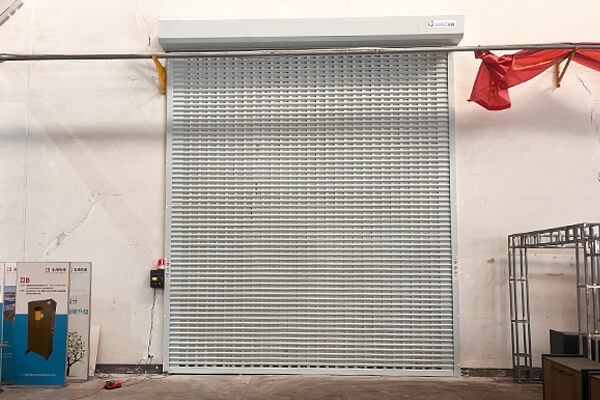

Perforated Aluminum Roller Shutter Door for Photovoltaic Equipment Manufacturing
Access, airflow and installation space are practical challenges in photovoltaic equipment design. The perforated aluminum roller shutter door offers vertical opening and allows air to pass through the closed curtain, making it an option for equipment enclosures where full sealing is not required.
Suitability depends on more than the opening dimensions. Perforation pattern, operating frequency and control requirements all matter. This guide explains where perforated aluminium roller shutters may fit in photovoltaic equipment manufacturing and what to check before specifying a door.
What Is a Perforated Aluminum Roller Shutter Door?
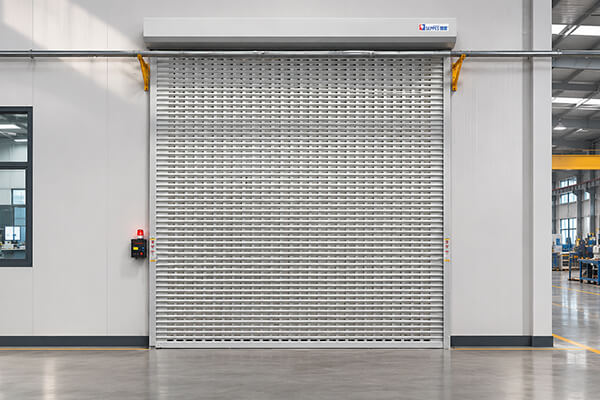
A perforated aluminum roller shutter door has a curtain made from interlocking aluminium slats with small openings. These perforations allow air and light to pass through the closed curtain while providing partial visibility. For photovoltaic equipment enclosures, this design may suit access openings where ventilation is needed and full sealing is unnecessary.
Basic Components and Operating Principle
Like other rolling shutter doors, the shutter moves vertically along side guides and coils around a shaft above the opening. This arrangement avoids the swing clearance needed by hinged doors, although the coil and guides still require installation space.
The main components are the slatted curtain, guide rails, roller shaft, bottom rail and drive mechanism. The guides direct the curtain’s movement, while the bottom rail reinforces its lower edge. Operation can be manual or motorised, depending on the configuration and access requirements.
How Perforated Curtains Differ from Solid Designs
A perforated curtain provides airflow paths through the slats; a solid curtain does not. The size, spacing and proportion of openings affect airflow, visibility and structural performance.
Neither design should be assumed to provide dust-tight sealing or machinery safeguarding. Selection depends on the enclosure’s function, environmental conditions and any identified hazards.
Why Consider Perforated Shutters for Photovoltaic Equipment?
Photovoltaic equipment designers often need to balance ventilation, inspection access and limited floor space. Perforated shutters can address these needs at suitable enclosure openings. Their value depends on the equipment layout, operating conditions and required level of separation.
Airflow Through a Closed Curtain
Equipment enclosures may need ventilation even when access openings are closed. A perforated curtain provides a path for air to pass through, which can support the enclosure’s ventilation design without leaving the door open.
However, perforations alone do not guarantee adequate cooling. Engineers should assess the open-area ratio, airflow resistance and equipment heat load alongside any fans or extraction systems. Where dust control or pressure separation is required, an open curtain may be unsuitable.
Partial Visibility for Equipment Inspection
Maintenance teams may need to check an indicator or identify an obvious obstruction before deciding whether to open an enclosure. Perforated slats can provide limited visual access while the shutter remains closed.
Useful visibility depends on hole size, lighting, viewing angle and the position of internal components. The curtain should therefore be assessed from the operator’s normal viewing position. It cannot replace a clear inspection window where detailed observation is essential.
Vertical Opening and Installation Space
Hinged doors require swing clearance that can conflict with neighbouring equipment, walkways or maintenance areas. A vertically coiling shutter avoids this swing area and may simplify access in compact production layouts.
The installation still needs sufficient headroom for the coil, side clearance for the guides and access for servicing. Confirming these dimensions early helps avoid clashes during equipment assembly.
Aluminum Rolling Shutter Doors: Material and Curtain Design
The curtain design of aluminum rolling shutter doors should match the enclosure’s operating environment and access requirements. For photovoltaic equipment, material selection, slat construction and perforation layout need to be assessed together rather than specified independently.
Slat Construction and Surface Finish
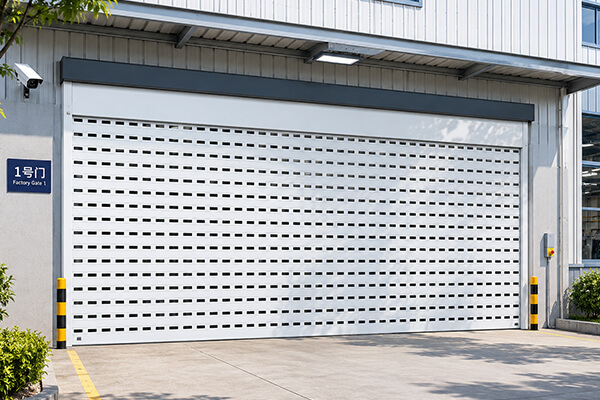
Interlocking aluminium slats form the curtain and allow it to coil above the opening. Slat profile, thickness and connection details influence the assembly’s weight, rigidity and rolling behaviour. Selection should follow the manufacturer’s verified limits for the opening dimensions and operating frequency.
Surface finish also deserves attention. Depending on the available product options, anodising or powder coating may be considered. Confirm compatibility with site humidity, cleaning agents and cleaning methods, particularly where chemical splashes or frequent wipe-downs are expected. Request maintenance guidance for the specified finish.
Perforation Pattern and Open-Area Ratio
When specifying an aluminum perforated rolling shutter, assess hole shape, hole size and spacing alongside the curtain structure. Open-area ratio describes the proportion of the perforated area occupied by openings; it does not directly state the airflow rate through the installed door.
A larger open area may support ventilation and visibility, but structural requirements and access to internal hazards must also be considered. Ask the supplier for the perforation drawing, the basis of its open-area calculation and relevant performance data.
Potential Applications in PV Manufacturing Equipment
A Perforated Aluminum Roller Shutter Door may suit selected access openings in PV manufacturing equipment where airflow, partial visibility and compact opening movement are useful. Each location should be assessed against the enclosure’s purpose, maintenance tasks and operating conditions.
Auxiliary Equipment and Service Enclosures
Service openings around auxiliary equipment may need to remain closed while allowing ventilation. A perforated curtain can be considered where technicians require occasional access to components and the equipment enclosure does not need sealed separation.
Before specifying the shutter, confirm the ventilation requirements, exposure to dust and compatibility with cleaning procedures. Avoid positions where airborne contamination or liquid splashes could pass through the perforations and affect sensitive components.
Maintenance Access Around Automated Handling Systems
Around automated handling equipment, hinged access doors can compete with conveyors, adjacent machinery or maintenance routes for space. A vertically coiling shutter may provide maintenance access without a door leaf projecting into these areas.
The opening must still accommodate the tools, replacement parts and technician movements required for servicing. Where it provides access to hazardous motion, the complete arrangement requires a safety assessment, including any necessary interlocking and measures against reaching through the curtain.
Peripheral Openings Near Assembly Equipment
Peripheral service openings near assembly equipment may benefit from a shutter where routine checks and occasional component replacement are required. Partial visibility can help staff assess whether closer inspection is needed.
Suitability depends on the processes nearby. Keep perforated designs separate from applications requiring controlled cleanliness, airtight separation, laser containment or sealed process chambers. Confirm the proposed location with the equipment designer before finalising the door configuration.
Electric Roller Shutter Doors: Drive and Control Integration
For photovoltaic equipment, electric roller shutter doors should be selected around the access task and operating cycle. A maintenance opening used a few times per shift has different requirements from a door that moves repeatedly during production.
Operating Frequency and Drive Selection
Define the expected cycles per hour, periods of continuous use and required opening time before selecting the drive. The supplier should confirm suitability for the curtain dimensions, weight and duty cycle.
Check the available power supply and space for the motor, cables and service access. Avoid specifying a faster opening speed without considering stopping behaviour, moving-door hazards and the equipment’s control sequence.
Door Position Feedback and Control Interfaces
The machine designer should define which signals are needed, such as open, closed, movement command and fault status. Confirm that the proposed drive and controller support these functions and document the interface before installation.
A standard position signal should not be assumed to perform a safety function. Where machine operation depends on the door’s position, specify the required safety functions separately and validate the complete arrangement.
Maintenance Access and Manual Operation
Consider how technicians will access the enclosure following a power failure or drive fault. Where manual operation is available, confirm how it works, where it can be reached and whether the curtain remains controlled during use.
Include the operating instructions in the equipment documentation. Manual opening does not replace the isolation procedures required before maintenance.
7 Essential Checks Before Specifying a Perforated Aluminum Roller Shutter Door
Before choosing a shutter for photovoltaic equipment, confirm how the opening will be used and what the enclosure must achieve. These seven checks provide a practical starting point for discussions with the supplier.
1. Clear Opening Dimensions
Specify the usable width and height required after installation. Allow for the tools, replacement parts and maintenance tasks that must pass through the opening.
2. Headroom and Side Clearances
Check the space available for the coil, guides, drive and mounting brackets. Include service access so components can be inspected or replaced without unnecessary dismantling.
3. Perforation Pattern and Ventilation Needs
Review hole size, spacing and open-area ratio against the enclosure’s ventilation requirements. Open-area percentage alone does not establish the airflow through the installed assembly.
4. Material, Finish and Cleaning Conditions
Confirm the slat specification and finish against humidity, cleaning agents and potential splashes. Ask for cleaning and maintenance instructions for the proposed configuration.
5. Operating Frequency and Drive Selection
Provide the expected cycles per hour, opening time and available power supply. The supplier should confirm that the drive is suitable for the curtain size, weight and operating pattern.
6. Control Interfaces and Position Feedback
Define the commands, position signals and fault information required by the equipment controller. Document supported interfaces before installation rather than assuming compatibility.
7. Safety and Maintenance Access
Assess hazards associated with door movement and access to equipment behind the curtain. Where reaching towards a machinery hazard is possible, consult relevant guidance such as ISO 13857 on machinery safety distances as part of the risk assessment. This reference does not establish certification of the door assembly.
How to Specify the Right Shutter for Your Equipment
Start with an installation drawing and a clear description of the opening’s purpose. These give the supplier a more useful basis for selection than width and height alone.
Opening Dimensions, Headroom, and Guide Clearances
Record the required clear opening, mounting arrangement and available space above and beside the enclosure. Confirm whether dimensions refer to the structural opening or the usable opening after installation.
Check for interference with cable trays, pipework, machine frames and adjacent access panels. Allow space to inspect and replace the motor, guides and curtain components without unnecessary equipment dismantling.
Environmental and Cleaning Conditions
Describe the conditions at the proposed opening rather than relying on a general factory specification. Relevant details include temperature, humidity, dust, cleaning agents and the possibility of liquid splashes.
For a ventilated equipment enclosure, establish whether air passing through the curtain could carry contamination towards sensitive components. Where separation is essential, consider a different curtain or enclosure design.
Safety Assessment and Access Requirements
Clarify whether the door provides service access, restricts unauthorised entry or forms part of a machinery safeguarding arrangement. These functions require different design considerations.
Assess access through the perforations, around the guides and beneath the curtain, as well as hazards created by door movement. Any required interlocking, protective devices or stopping functions should be specified by the responsible machine designer.
Use the following checklist when requesting a configuration:
Perforated vs. Solid Shutters for Equipment Enclosures
Choosing between perforated and solid shutters starts with the enclosure’s function. Ventilation and partial visibility may be useful in one location, while another requires greater separation from the surrounding environment.
| Consideration | Perforated curtain | Solid curtain |
|---|---|---|
| Air passage | Provides openings through the slats | No perforations through the slats; other gaps may remain |
| Visibility | Allows limited views under suitable conditions | Blocks direct viewing through the curtain |
| Dust and splash separation | Openings permit passage | May provide greater separation, depending on the complete assembly |
| Cleaning | Perforations introduce additional edges to clean | Continuous slat surfaces may simplify some cleaning tasks |
| Installation | Requires coil, guide and service clearances | Also requires coil, guide and service clearances |
| Safety function | Must be assessed for the intended use | Must also be assessed for the intended use |
Neither construction alone establishes airtightness, cleanliness or machinery protection. If the opening serves a controlled process area, specify the required performance first and ask the supplier to confirm whether the complete door assembly can meet it.
Frequently Asked Questions
Is a Perforated Aluminium Roller Shutter Different from an Aluminum Version?
“Aluminium” and “aluminum” are regional spellings of the same material name. A Perforated Aluminium Roller Shutter is therefore not a different product category solely because of its spelling. Compare the actual alloy, slat profile, dimensions, perforation pattern and drive specification when reviewing quotations.
Can the Door Be Connected to a Machine Control System?
Connection may be possible where the selected controller supports the required commands and feedback. Confirm signal types, electrical requirements and fault behaviour with both suppliers. Any safety-related communication or interlocking needs separate specification and validation; ordinary control compatibility does not establish safety performance.
Does a Perforated Curtain Provide Dust-Tight Separation?
No. The perforations create open paths through the curtain, so it should not be specified as a dust-tight barrier. If sensitive components require protection from airborne particles, review the enclosure design, ventilation route and filtration requirements before choosing the door.
What Information Is Needed for a Custom Quotation?
Provide the clear opening dimensions, installation drawing, available mounting space, operating frequency and site power supply. Add details of the environment, finish, perforation needs and control interfaces. Explain the maintenance task and any identified safety requirements so the supplier can assess the proposed configuration accurately.
Discuss Your PV Equipment Shutter Requirements
Selecting a Perforated Aluminum Roller Shutter Door starts with understanding the access opening and its role in the equipment. Confirm ventilation needs, maintenance space, operating frequency and control requirements before finalising the configuration.
Share your opening dimensions, equipment layout and operating conditions to discuss a suitable shutter arrangement. Include any requirements for environmental separation or machinery protection so these can be assessed during the selection process.
