


What Is a Rapid Coiling Door? Types, Benefits & Industrial Applications
In industrial and logistics environments, every second of door operation impacts efficiency, safety, and energy costs. Traditional roll-up doors often struggle to keep up with high-traffic workflows, temperature-controlled spaces, and modern automation demands. This is where the rapid coiling door has become a critical upgrade for warehouses and manufacturing plants worldwide.
But what exactly is a rapid coiling door, and why is it increasingly specified in industrial facility design? This article explores the fundamentals behind this high-performance door system—how it works, what makes it different from conventional rolling doors, and where it delivers the greatest value. You’ll gain a clear understanding of its structure, operating principles, and key advantages, along with insights into common applications and selection considerations.
Whether you’re a facility manager looking to improve operational efficiency, an engineer evaluating door performance, or a procurement professional comparing industrial door solutions. This guide will help you understand when and why industrial rapid coiling doors are the right choice—before you move on to detailed specifications decisions.
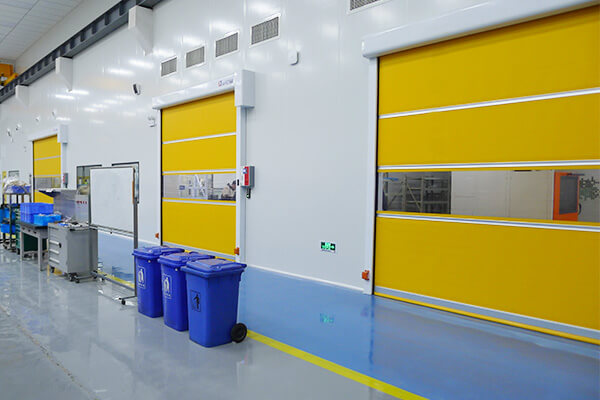
What Is a Rapid Coiling Door?
A rapid coiling door is a high-speed industrial door that opens and closes quickly, keeping your workflow efficient. Its curtain rolls on top of the door and keeps the opening clear for rapid and regular passage while reducing air flow from your facility. This helps your facility increase productivity, retention of controlled indoor climates, and safety rapidly, which is why they are used in warehouses, factories, cold storages, and logistics centers where doors are used frequently.
Rapid Coiling Door vs Industrial Roller Door
| Feature | Rapid Coiling Door | Industrial Roller Door |
| Opening Speed | Very fast, designed for frequent and continuous operation | Slow to moderate, not suitable for high-cycle use |
| Primary Purpose | Improve efficiency, reduce air exchange, support high traffic flow | Provide basic access and security |
| Typical Operation | Fully automatic with sensors or remote control | Manual or motorized |
| Usage Frequency | High-cycle (hundreds of operations per day) | Low to medium cycle |
| Door Material | Flexible PVC or lightweight aluminum curtain | Steel or aluminum slats |
| Energy Efficiency | High – minimizes heat loss and air infiltration | Low to moderate |
| Safety Features | Built-in sensors, soft bottom edge, auto-reverse | Limited safety features |
| Environmental Control | Excellent for temperature, dust, and airflow control | Minimal environmental sealing |
| Common Applications | Warehouses, cleanrooms, cold storage, logistics centers | Factories, garages, storage units |
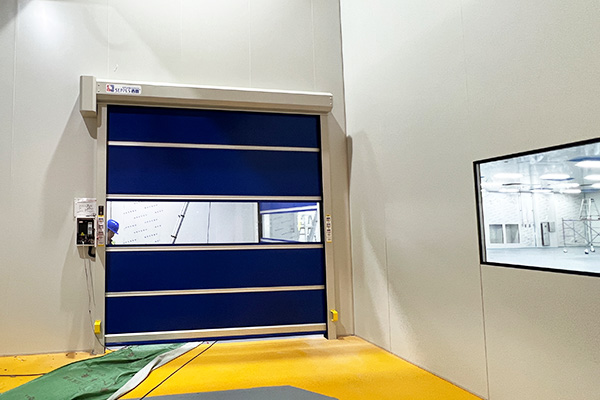
Key Components of Rapid Roller Coiling Doors
Door curtain / materials
Common materials: flexible PVC fabric (lightweight, fast, good seal), aluminum (lightweight rigid slats or extrusions), and steel (heavy duty, security).
When to pick which: PVC for ultra-fast internal and temperature-controlled openings; aluminum for exterior doors needing wind resistance; steel where security and impact resistance matter.
Motor & drive system
Typical setup: an electric motor controlled by a variable-frequency drive (VFD / frequency inverter) or purpose-built high-speed motor to precisely control acceleration, max speed and soft stops. VFDs are standard for smooth high-speed operation and energy efficiency.
Sensors & safety features
Common safety devices: photoelectric beams (infrared “safety eyes”), light-curtain/laser arrays, radar motion detectors, monitored bottom safety edges and anti-jam sensors. If an obstruction is detected the door stops or reverses.
Advanced options: traffic-sensing light curtains and alert lights, or integrated LED warnings for busy dock areas. These reduce collisions and downtime.
Control systems & integration
Controller types: purpose-built door controllers or PLC-based controllers with self-diagnostics, parameter tuning and encoder feedback.
Types of Rapid Coiling Doors and Their Applications
High speed coiling doors are designed to meet different operational, environmental, and structural requirements. Based on construction and performance, they are commonly divided into three main types, each suited to specific use cases within industrial and commercial facilities.
PVC Rapid Roll Doors
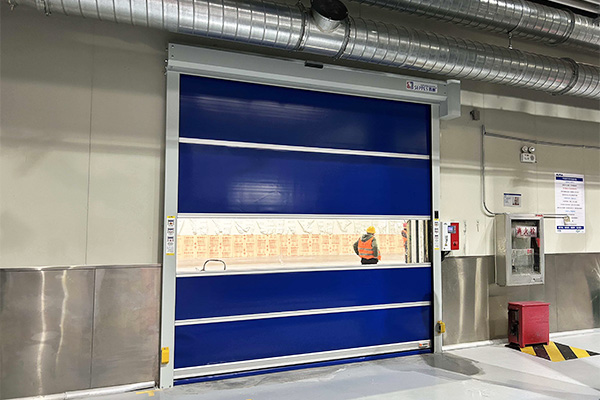
PVC rapid roll doors feature a flexible PVC fabric curtain. Their lightweight structure allows for very fast opening and closing speeds, making them ideal for areas with frequent traffic.
Because the curtain is soft and flexible, these doors are designed primarily for interior use or semi-protected environments. They often include self-repairing zipper or brush systems that allow the curtain to reinsert itself into the tracks after impact.
Best-fit applications include:
- Logistics and distribution centers
- Warehouse internal partitions
- Manufacturing process separation
- Cleanrooms and food-processing areas
Spiral Rapid Coiling Doors

Spiral rapid coiling doors use rigid aluminum panels that travel along a spiral-shaped track. This design reduces curtain wear and allows for higher durability, while still maintaining rapid operation.
Compared with PVC doors, spiral doors offer greater wind resistance, impact strength, and security, making them suitable for exterior openings. Their rigid panels also provide a cleaner appearance and improved long-term stability.
Best-fit applications include:
- External loading bays
- Building and facility perimeters
- Automotive plants and heavy manufacturing
- Locations requiring both speed and security
Spiral high speed doors are often selected where high performance and architectural durability are equally important.
Overhead Rapid Coiling Doors
Rapid coiling overhead is the combination of a classic overhead roller mechanism with quick action rapid doors. High speed roll up doors have stronger curtains, heavy-duty guides, or anti-wind bars to withstand windy, outdoor environments.
This type of industrial rapid roll door is built to withstand heavy industrial cycle doors. Rapid coiling doors withstand different environments with varied dust, temperatures, and wind. Compared to the interior doors made of PVC, rapid door coiling is a slightly less cycles. With a good balance of strength, reliability, and speed, coiling doors have good performance.
Best-fit applications include:
- Industrial warehouses with exterior openings
- Distribution centers with frequent truck traffic
- Production facilities requiring continuous operation
- Industrial environments with wind or pressure challenges
In summary, choosing the right type of high speed coiling door depends on whether the priority is speed, durability, environmental resistance, or security. Matching the door type to its application ensures long-term performance and operational efficiency.
Top Benefits of Rapid Coiling Doors for Industrial Facilities
Boost Operational Efficiency
With an opening speed of 1.5 m/s—far exceeding standard industrial rolling doors (≤0.5 m/s)—these doors drastically cut waiting time for vehicles and forklifts. In high-frequency usage scenarios, they improve throughput and eliminate bottlenecks at transfer points, enabling smoother operations, higher productivity, and fewer labor delays.
Enhance Safety & Reduce Accidents
Equipped with infrared safety sensors, motion detectors, and soft bottom safety edges, the doors automatically stop or reverse when detecting people, vehicles, or objects in the opening. High-speed operation also minimizes the time the door stays half-open, lowering collision risks and better protecting employees, vehicles, and goods.
Energy Conservation & Environmental Protection
Rapid opening and closing reduce air exchange by 70–80% compared to slow-opening doors, maintaining stable indoor temperatures. This eases HVAC load in cold storage and temperature-controlled facilities, leading to significant savings in heating and cooling costs, especially in high-traffic areas.
Superior Cleanliness & Dust Resistance
Tight side rails and bottom sealing strips block dust, insects, and air pollutants, while fast operation shortens exposure to the external environment. Ideal for food processing, pharmaceutical production, and clean room adjacent areas, they improve hygiene, maintain a clean workspace, and simplify compliance with industry standards.
High Durability & Minimal Downtime
Built for high-cycle use, these doors adopt reinforced curtain fabrics, self-repair systems, and variable frequency motors to reduce mechanical stress. Fewer breakdowns mean less unplanned downtime and lower long-term maintenance costs, ensuring reliable performance in harsh industrial environments.
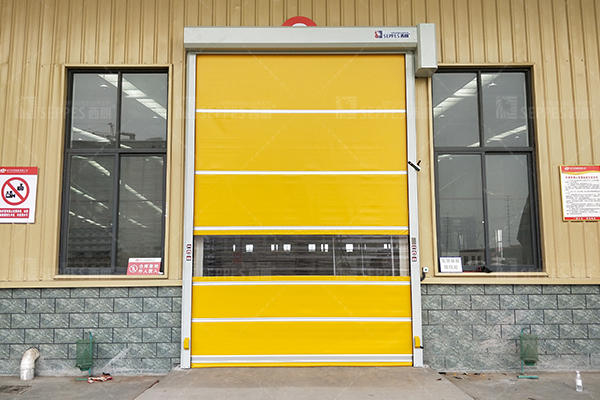
How to Choose the Right Rapid Coiling Door for Your Facility
Speed Requirements (Cycles per Hour)
Consider how frequently the door will be utilized. Halls like logistics corridors and production lines will require hundreds of cycles a day and a door with higher opening/closing speeds and high cycle rated motors. For moderate use areas, a little less speed might be okay while efficiency is maintained. With a door that is tailored to your cycle frequency, you can avoid premature wear and avoid untimely downtimes.
Environmental Conditions
The environment where the rapid roll doors are going to be placed is extremely important. When it comes to cold storage and temperature-controlled areas, doors need to be rapid and seal well to minimize air exchange and to prevent losing energy. However, outdoor or semi-exposed zones need more reinforced designs to withstand higher winds, corrosion, and relative humidity. Aligning the doors to the surrounding environment will guarantee optimal performance all year around.
Material & Durability Needs
Rapid coiling doors are available in different materials to suit varying applications. Flexible PVC curtains are ideal for internal areas where speed and self-repairing capabilities are priorities. Aluminum or reinforced designs provide greater durability and impact resistance for external or high-risk areas. Selecting the right material reduces maintenance costs and extends service life.
Sealing Performance
Effective sealing is essential for energy efficiency and contamination control. Look for doors with tight side guides, bottom seals, and optional insulation features. Strong sealing reduces dust, humidity, and temperature transfer, making these doors particularly valuable in food processing, pharmaceutical, and cleanroom-adjacent environments.
Safety Features & Compliance Standards
Safety should never be compromised. Modern rapid coiling doors should include photoelectric sensors, soft bottom safety edges, and automatic stop or reverse functions. Ensure the door complies with relevant local or international safety standards, especially in facilities with heavy vehicle or pedestrian traffic.
Automation & Integration Capabilities
Finally, consider how the door integrates with your existing systems. Many rapid coiling doors support sensor activation, access control, PLC systems, and warehouse automation platforms. Integration improves workflow efficiency, reduces manual operation, and supports smarter facility management.
High speed coiling doors are high-speed industrial doors designed to open and close quickly, helping my facility move people, vehicles, and goods more efficiently. They improve workflow, enhance safety with built-in sensors, save energy by minimizing air exchange, and maintain a cleaner environment. Durable and built for high-cycle use, they also reduce downtime and maintenance needs.
If I want to upgrade my operations, I can contact a supplier to get a quote, schedule a site survey, or request a product catalog to find the right solution for my facility.
FAQs
Are rapid coiling doors suitable for cold storage?
Yes. Rapid coiling doors are ideal for cold storage and temperature-controlled environments because their fast operation minimizes air exchange. Many doors also feature tight side guides, insulated PVC curtains, and bottom seals to maintain consistent indoor temperatures and reduce HVAC energy consumption.
What is the maintenance cost of a rapid coiling door?
Maintenance costs are generally low compared to traditional industrial doors. Most high-quality rapid coiling doors are designed for high-cycle use, with reinforced curtains, self-repair systems, and variable-frequency motors that reduce mechanical stress. Routine inspections and occasional component replacement (motors, sensors, or bottom edges) are usually sufficient to keep the doors running smoothly.
What is the difference between a sectional door and a coiling door?
- Rapid coiling doors: Open vertically at very high speed, with lightweight PVC, aluminum, or steel curtains. Designed for high-cycle, energy-efficient, and controlled environments.
- Sectional doors: Consist of hinged panels that roll up along tracks; typically slower and heavier, suitable for security and standard industrial or garage applications.
Rapid coiling doors outperform sectional doors in speed, cycle frequency, environmental sealing, and automation integration.
Where are warehosue rapid roller doors most commonly used?
They are widely used in warehouses, logistics centers, manufacturing facilities, cold storage rooms, cleanrooms, and food processing plants. These environments benefit from fast access, energy savings, enhanced safety, and dust or contamination control.


 English
  Chinese
  Arabic
  German
  Spanish (Mexico)
  French
  Uzbek
Uzbek  Russian
  Japanese
  Korean
  Spanish (Peru)
  Spanish (Venezuela)
  Spanish (Ecuador)
  Spanish (Puerto Rico)