


What Is The Difference Between Fast Rolling Doors And Ordinary Rolling Shutter Doors?
In industrial, commercial, and logistics scenarios, high speed industrial doors serve as essential equipment for passage management, environmental isolation, and safety protection. However, many businesses struggle to distinguish between fast rolling doors and ordinary rolling shutter doors, leading to mismatched purchases that fail to meet efficiency, hygiene, or energy-saving needs. For example, using ordinary rolling shutter doors in high-frequency logistics warehouses can cause long waiting times, while fast rolling doors can meet the needs of frequent and quick passage.
This article will comprehensively analyze the differences between the two types of industrial doors–Fast Rolling Door vs Rolling Shutter Door. It will help you make informed decisions based on your actual requirements.
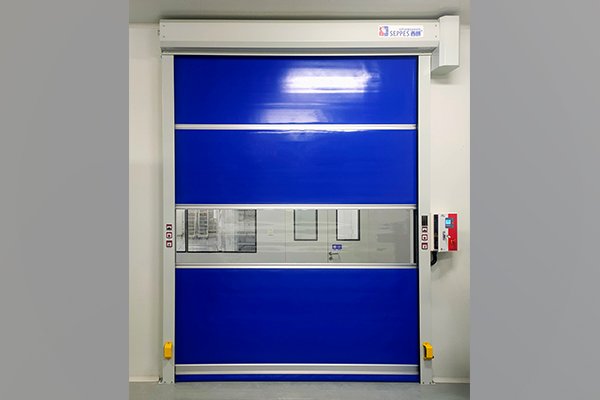
What Is A Fast Rolling Door?
The fast rolling door is an electric high speed industrial door. Its running speed exceeds 0.8 meters per second. It can open and close the door quickly to the greatest extent. It has many functions, such as heat preservation, cold preservation, insect proof, wind proof, dust proof, sound insulation, peculiar smell proof, lighting, etc., and is widely used in food, chemical, textile, electronic, supermarkets, refrigeration, logistics, warehousing and other places can meet high-performance logistics and clean places, and save energy, automatically shut down at high speed, improve operating efficiency, and create a better operating environment.
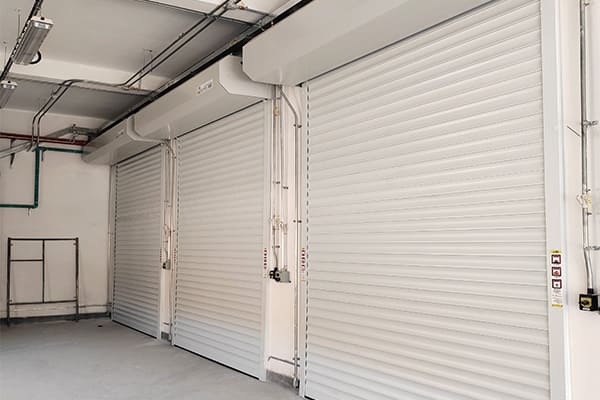
What Is A Rolling Shutter Door?
A basic protective door with a simple structure. Driven by a common motor or manually, its door body is mostly composed of spliced metal plates. It focuses on basic security (anti-theft, shielding) and cost control, suitable for simple isolation needs with low-frequency use.
Core Differences: Fast Rolling Door vs Ordinary Rolling Shutter Doors
Ordinary rolling shutter doors have slower switching speeds, louder noise, and lower switching frequency. They are usually installed and applied to external doors, while PVC fast rolling doors switch Fast speed, low noise, high switching frequency, usually installed in the interior of the workshop door.
| Comparison Dimension | Fast Doors | Roller Shutter Doors |
|---|---|---|
| Opening/Closing Speed | Opening speed ≥1m/s. Rapidly isolates internal and external environments, reducing energy loss and waiting time for forklifts. | Opening speed 0.2-0.8m/s. Slow operation, leading to long queues in high-frequency scenarios, affecting work efficiency. |
| Drive & Control | Equipped with high-frequency dedicated motor + servo control system. Supports infrared, radar, geomagnetic, and other intelligent induction modes, realizing contactless automatic opening. | Mostly driven by ordinary motors or manually. Limited control methods (remote control/wall switch), lacking intelligent induction functions, requiring manual operation. |
| Door Material & Structure | High-strength polyester fiber base cloth or PVC material. Flexible, wear-resistant, and tear-resistant. Tracks are designed with sealed brushes for enhanced isolation. | Aluminum alloy, color steel plates, and other metal plates. Rigid structure, poor flexibility. Simple design with weak sealing at plate joints. |
| Sealing & Energy Saving | Door body fits tracks + brush sealing. Excellent dustproof, insect-proof, thermal insulation effects. Reduces indoor and outdoor energy exchange, lowering air conditioning/refrigeration energy consumption by 20-30%. | Gaps easily form at plate joints. Only basic dustproof performance. Poor thermal insulation, resulting in significant energy waste in temperature-controlled environments. |
| Safety Configuration | Standard with infrared photoelectric induction, bottom rebound device, and emergency stop function. Effectively prevents pinching of people or objects, with high safety factor. | Simple safety configuration, mostly only basic anti-pinch functions. Some manual models lack safety protection, posing potential risks of pinching or collision. |
| Operating Noise | Dedicated silent motor + flexible door body design. Operating noise ≤60dB, no interference to workshop production or commercial environments. | Metal plates rub against tracks severely, and ordinary motors produce obvious noise. High noise pollution during high-frequency use. |
| Durability & Maintenance | High-frequency motor matches wear-resistant door body. Anti-aging and wear-resistant, with a service life of 5-8 years. Low maintenance frequency, only requiring regular cleaning. | Metal plates are prone to deformation and wear. Motors are poorly adapted to high-frequency operation, leading to increased failure rates and rising maintenance costs over time. |
| Initial Purchase Cost | Higher cost due to precision components (high-frequency motor, intelligent sensors, high-quality materials). | Lower cost, with simple structure and low technical threshold, suitable for budget-limited scenarios. |
Conclusion
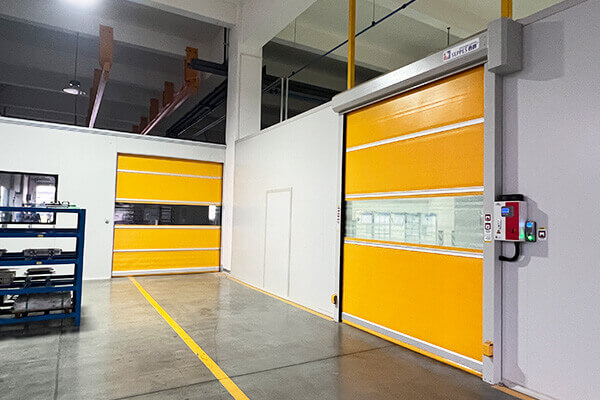
The core distinction between high-speed rolling doors and standard rolling doors lies in performance and application scenarios. High-speed rolling doors are engineered for high-efficiency, high-standard environments, while standard rolling doors are designed for basic, low-demand scenarios.
When making a selection, focus on two key aspects:
- Daily traffic frequency (prioritize high-speed rolling doors for ≥100 cycles/day).
- Environmental requirements (high-speed rolling doors are a must for scenarios requiring strict cleanliness or temperature control). While for basic needs with low traffic frequency and limited budgets, standard rolling doors can meet the requirements.
If you’re unsure about the suitable model, contact professional manufacturers for on-site inspections. SEPPES specializes in industrial high-speed doors, having provided high-speed door solutions for over 5,600 enterprises and factories—including more than 70 Fortune 500 companies such as Fresenius, IKEA, and Tyson Foods.

