医薬品施設向けクリーンルーム高速ドアソリューション
In pharmaceutical manufacturing, every detail of a cleanroom environment matters. Airflow control, hygiene, operational safety and material movement all influence how efficiently a facility can maintain controlled conditions. For areas with frequent traffic, the door system is often one of the most important yet overlooked parts of the cleanroom design. A designed clean room high speed door solutions helps reduce unnecessary air exchange, supports smoother internal logistics and improves the separation between controlled zones.
Compared with standard industrial doors, high speed clean room doors are designed with cleaner surfaces, faster operation and configurations that better suit pharmaceutical, biotech, medical device and clean manufacturing environments.

Why Pharmaceutical Facilities Need Clean Room High Speed Doors
Pharmaceutical production areas usually require strict control over dust, airflow, temperature, humidity and personnel movement. When doors open slowly or remain open for too long, clean areas may be exposed to higher contamination risk and pressure instability.
A professional speed door solution helps solve this problem by opening and closing quickly during daily operation. This is especially useful in clean corridors, production rooms, packaging areas, laboratories and material transfer zones.
For pharmaceutical facilities, the purpose is not only speed. The door must also support hygiene, safety and long-term reliability. This is why cleanroom door design should consider curtain material, sensor protection, structural cleanliness and control box installation at the same time.
In a pharmaceutical facility, door performance is closely connected to contamination control, workflow efficiency and daily cleaning. The table below shows common operational challenges and how a clean room high speed door solution can help address them.
| Challenges in Pharmaceutical Facilities | Operational Pain Points | High Speed Door Solution |
|---|---|---|
| Frequent movement of personnel, trolleys and materials | Doors remain open for too long, increasing air exchange between clean and non-clean areas | Fast opening and closing helps reduce open time and supports better separation between controlled zones |
| Pressure differences between cleanroom areas | Slow or poorly sealed doors can disturb pressure balance and affect cleanroom stability | High speed cleanroom doors support rapid closure and improved sealing performance |
| Dust and particle control requirements | Exposed screws, gaps or uneven surfaces may collect dust and make cleaning more difficult | Screw-free front design and smooth surfaces help simplify cleaning and reduce dust accumulation points |
| Static-sensitive production environments | Static electricity may affect powders, packaging materials or sensitive equipment | 2.5mm anti-static curtain helps reduce static-related risks in controlled areas |
| High-frequency cleanroom traffic | Conventional doors may slow down workflow and create bottlenecks in production corridors | High speed door solutions improve access efficiency for operators, carts and material flow |
| Safety risks during fast movement | People or trolleys may pass through the doorway during door operation | Three pairs of photoelectric sensors improve detection coverage and help reduce collision risks |
| Limited wall space in clean corridors | Protruding control boxes may obstruct movement and complicate cleaning | Embedded wall-mounted control box keeps the wall surface flat without external protrusions |
| Strict hygiene and GMP expectations | Door structures must support routine cleaning, inspection and long-term hygiene management | Cleanroom-oriented door design supports easier maintenance and more professional facility operation |

Key Features of Clean Room High Speed Door Solutions
2.5mm Anti-Static Door Curtain
Static control can be important in sensitive production areas, especially where powders, packaging materials, electronic equipment or delicate processes are involved. A 2.5mm anti-static curtain helps reduce static-related risks while maintaining flexible and frequent operation.
初めて high speed fabric roll up doors, the curtain should be durable, easy to clean and suitable for repeated opening cycles. In cleanroom applications, the surface should also support simple daily maintenance without unnecessary grooves or exposed details.
Three Pairs of Photoelectric Safety Sensors
Safety is essential in high-frequency cleanroom traffic areas. Three pairs of photoelectric sensors can improve detection coverage for people, trolleys and material movement. This helps reduce collision risk and supports safer daily use.
ある high speed roll up door for clean room areas, sensor configuration should be selected according to traffic frequency, opening width and the types of goods passing through the doorway.
Screw-Free Front Design
A screw-free front enclosure gives the door a cleaner appearance and reduces exposed fixing points. In pharmaceutical facilities, this detail matters because smoother front surfaces are easier to clean and less likely to collect dust.
This design also supports a more professional installation finish, especially in clean corridors and high-visibility production environments.
Embedded Control Box with No Protrusion
An embedded wall-mounted control box helps keep the installation surface flat and tidy. With no external protrusion, the surrounding wall area is easier to clean and less likely to interfere with people, carts or equipment moving through the cleanroom.
For pharmaceutical projects, this is a practical detail that improves both hygiene and workflow.
Pharmaceutical High-Speed Door Applications
Pharmaceutical high-speed doors can be used in many controlled areas, including:
- Cleanroom corridors
- Production rooms
- 包装工場
- Laboratory access points
- Material transfer areas
- Biotech and medical device facilities
- Clean manufacturing plants
The right door solution should match the cleanroom grade, traffic type, opening frequency and wall structure. It should also be customised according to site dimensions and operating requirements.
Project Reference: Cleanroom Door Solution for a Global Pharmaceutical Company
プロジェクトの背景
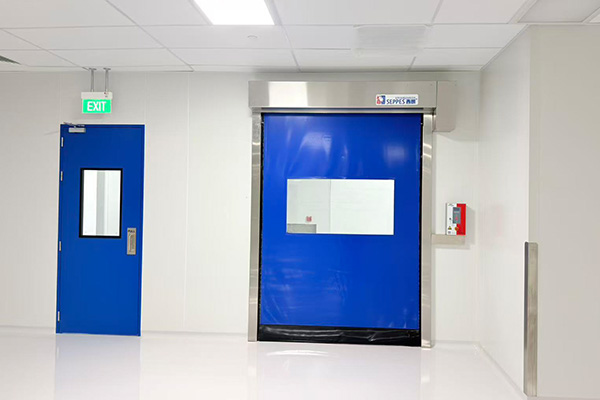
The project was supplied for AstraZeneca Pharmaceutical China, a global pharmaceutical company with high standards for production environments. The door configuration focused on clean installation, safer access and better compatibility with pharmaceutical cleanroom requirements.
Main Challenges
The main challenges were typical of pharmaceutical cleanroom applications. Operators and material trolleys needed to move efficiently between areas, but conventional door systems could increase opening time, disturb airflow and create potential dust accumulation points. The project also required a cleaner installation appearance, safer doorway protection and a control system that would not protrude into the working area.
Rapid Speed Door Solution
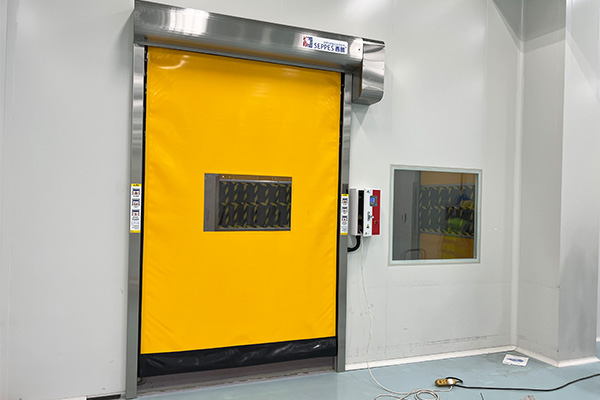
To address these challenges, customized speed door solution was provided for AstraZeneca Pharmaceutical China. The installed high speed cleanroom doors were configured with a range of features designed for pharmaceutical applications, including:
| 構成 | Benefits for Pharmaceutical Applications |
|---|---|
| 2.5mm anti-static curtain | Helps reduce static-related risks in sensitive production areas and supports controlled environments |
| High-speed opening and closing operation | Minimizes door open time, improves material flow efficiency and reduces unnecessary airflow exchange |
| Three pairs of photoelectric sensors | Provides wider detection coverage for operators, carts and material movement, improving operational safety |
| Screw-free front enclosure design | Creates a smoother surface with fewer dust accumulation points and simplifies cleaning |
| Embedded wall-mounted control box | Keeps the installation surface flat without external protrusions, optimizing cleanroom space utilization |
The anti-static curtain helps support static-sensitive pharmaceutical production environments, while the rapid opening and closing cycle improves workflow efficiency for operators and material transportation.
The advanced safety sensor system enhances protection during frequent traffic, while the screw-free structure and embedded control design provide a cleaner appearance that meets the expectations of modern pharmaceutical facilities.
How to Choose the Right Speed Door Solution
When selecting a cleanroom door, facility managers and project engineers should consider more than the basic door size. The following points are particularly important:
Cleanroom Compatibility
The door should support controlled environments with smooth surfaces, reliable sealing and easy cleaning. Avoid designs with unnecessary exposed components in sensitive areas.
ドアカーテン材質
For pharmaceutical and clean manufacturing facilities, anti-static fabric can be a strong option. It supports frequent operation while helping reduce static concerns in controlled spaces.
Safety Sensor Configuration
The number and position of sensors should match the movement of people, trolleys and goods. A higher level of detection is often useful in busy cleanroom passages.
Installation Details
A screw-free front and embedded control box can improve hygiene and reduce physical obstruction. These details are especially valuable in pharmaceutical environments where cleanability is a daily requirement.
Customisation
Every facility is different. A good supplier should be able to customise door size, curtain material, control method, safety devices, opening speed and installation structure.
結論
Cleanroom access points play a direct role in pharmaceutical production efficiency and environmental control. A well-designed clean room high speed door solution can help improve traffic flow, reduce air disturbance, support hygiene requirements and create a safer working environment.
For pharmaceutical, biotech and clean manufacturing facilities, the ideal speed door solution should combine fast operation with anti-static materials, reliable safety sensors, clean structural design and site-specific customisation. By choosing the right high speed clean room doors, companies can support cleaner production areas and more efficient daily operations.
よくある質問(FAQ)
What is the difference between a standard high speed door and a pharmaceutical high-speed door?
A standard high speed door is mainly designed for industrial traffic efficiency. A pharmaceutical high-speed door usually requires cleaner surfaces, better sealing, anti-static curtain materials, safer sensor systems and installation details that support cleaning and controlled environments.
How does proper door installation and expert installation affect uptime and energy efficiency?
Proper door installation, including high-speed door installation and commercial door install and service, ensures optimal performance and uptime by reducing failures and the need for emergency repairs. Expert installation by local dealers or a Rytec dealer helps maximize energy efficiency—cutting heating and cooling costs—by ensuring seals, guides, and control systems are correctly set, which is especially important in food processing, automotive, and cold-storage applications.
What preventative maintenance or preventive maintenance is needed to minimize downtime for high-performance doors?
Preventative maintenance programs and regular door repair and maintenance extend the life of high-performance and industrial high-speed doors. Routine checks include inspecting springs, guides, sensors, and drive systems, lubricating moving parts, and testing safety features. Scheduled maintenance reduces emergency callouts, supports uptime, and can be part of a maintenance program offered by local service providers or Rytec’s network to keep doors operating at per second speeds and with minimal maintenance.
What are the benefits of an embedded control box?
An embedded wall-mounted control box keeps the control system flush with the wall. This avoids external protrusion, reduces obstruction in clean corridors and supports easier cleaning around the doorway.
How do high-speed door systems improve safety and reduce damage in industrial environments?
High-speed door systems enhance safety through features like soft-edge construction, breakaway panels, motion sensors, and controlled closing speeds to prevent impacts. Self-repairing designs and heavy-duty yet flexible materials reduce the risk of damage and costly repairs after incidental contact. Properly maintained doors also ensure compliance with safety standards in commercial and industrial settings.
Are there specific high-performance or heavy-duty options for applications like automotive or food processing facilities?
Yes. For automotive and food processing facilities, manufacturers offer high-performance doors and heavy-duty high-speed door systems tailored to the environment. Options include stainless-steel components, food-safe fabric doors, high wind and pressure resistance, and models that achieve fast open rates (specified in inches per second or per second metrics) while minimizing air infiltration and contamination risk.
How can I choose between spiral doors, folding, sliding doors, or standard overhead doors for my facility?
Selection depends on space, traffic volume, environmental control needs, and desired uptime. Spiral doors and roll-up high-speed doors provide fast cycles and compact overhead space use, while folding or sliding doors may be preferred for wider openings. Consider high-speed door installation requirements, energy efficiency, and maintenance programs; consult local dealers or installers experienced with commercial overhead door options to match the highest quality solution to your application.