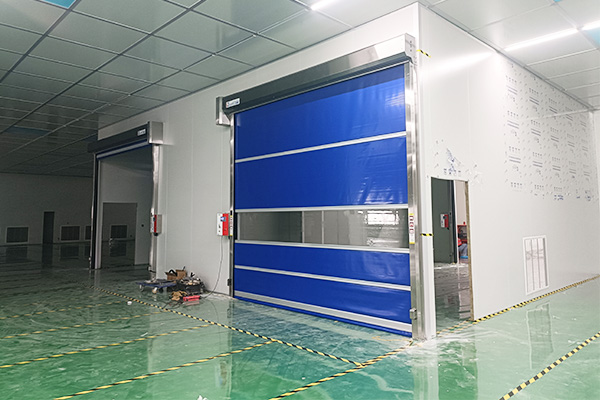
Rapid Speed Doors for Automotive Production Lines: Applications, Performance Benefits, and Selection Guide
Modern automotive manufacturing relies on speed, precision, and uninterrupted workflows. As production lines become more automated and data-driven, even small inefficiencies—such as heat loss, air contamination, or delays between process zones—can reduce productivity and increase operating costs. Maintaining smooth material flow while ensuring safety and environmental control has therefore become a key challenge for automotive plants.
Rapid speed doors play a critical role in addressing these challenges. Designed for frequent opening and closing, they enable the efficient movement of vehicles, components, AGVs, and personnel between production areas. From body welding and painting to final assembly and internal logistics, high speed roller doors help maintain pressure balance, temperature stability, and clean working conditions—all essential for improving automotive manufacturing efficiency.
As smart production systems continue to develop, the use of speed doors in automotive production lines is receiving increasing attention from plants. This article examines how rapid speed roller doors support efficient automotive operations, their key application areas, and the selection criteria that make them an essential component of modern automotive manufacturing facilities.

Why Choose Rapid Speed Doors as Automotive Production Line Door?
Any delay in material movement or environmental fluctuation can disrupt the entire assembly process. Industrial speed roll up doors provide a critical solution to these challenges.
Improve Workflow and Reduce Bottlenecks
Standard industrial doors open slowly, forcing forklifts and assembly carts to come to a full stop and wait. This cumulative downtime hurts production line workflow optimization.
- Rapid Access: Speed doors operate at speeds up to 2.5 meters per second, allowing traffic to pass through without hesitating.
- High-Cycle Durability: Designed for high-frequency use (opening hundreds of times per day), they prevent the mechanical failures common with standard rolling shutters in busy plants.
Seamless Integration with Production Automation
Modern car factories rely on robotics. Speed doors industrial automation capabilities allow them to become active in the machine logic.
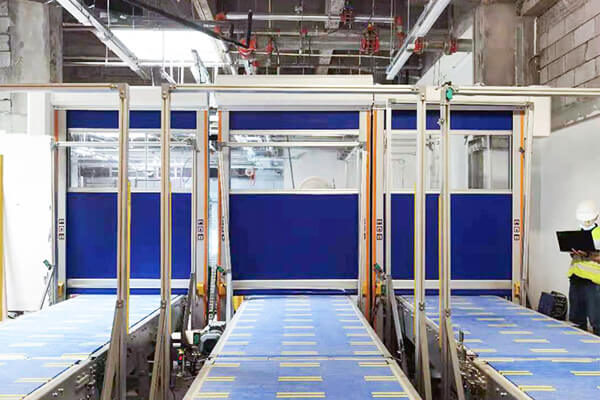
- Smart Connectivity: These doors communicate directly with Automated Guided Vehicles (AGVs), conveyor belts, and robotic welding cells.
- Just-in-Time Opening: The door opens automatically the moment an AGV approaches and closes immediately after it passes, ensuring continuous movement without human intervention.
Maintain Environmental Control
Certain automotive processes—such as painting, coating, and EV battery assembly—require strict climate stability.
- Minimized Air Exchange: The rapid opening and closing cycle significantly limits the time the doorway is open. This prevents dust from entering paint shops and maintains the low-humidity environments required for battery dry rooms.
- Energy Savings: By keeping conditioned air inside, speed doors contribute to overall automotive manufacturing efficiency and reduce HVAC energy costs.

Key Benefits of Fast Speed Doors in Automotive Production
In the high-pressure environment of automotive production, every second impacts the bottom line. Rapid speed doors are more than just a barrier; it is a critical instrument for optimising plant logistics and process integrity. Here are the four core values these doors bring to automotive manufacturers:
Increased Productivity and Reduced Downtime
- Eliminating Logistics Bottlenecks: Traditional roller shutters operate slowly, forcing AGVs and forklifts to idle while waiting for access. Industrial high speed roll up doors open at speeds of up to 1.5 m/s, creating an instant opening that keeps traffic moving without delay.
- Seamless Production Flow: By integrating with the factory’s central control system, these doors ensure a continuous workflow. They prevent costly assembly line stoppages often caused by door lag or mechanical failures in standard doors.
Energy Savings and Climate Control
- Stabilizing Internal Temperatures: In sensitive zones like Paint Shops and assembly areas, maintaining consistent humidity and temperature is vital for product quality. The fast cycle time of a rapid speed door drastically minimizes air exchange, preventing external drafts from destabilizing the internal environment.
- Reducing Operational Costs: By limiting the time the door remains open, facilities can significantly reduce the load on HVAC systems. This leads to substantial, long-term energy cost savings and supports the facility’s sustainability goals.
Enhanced Safety for Personnel and Equipment
- Intelligent Collision Prevention: While efficiency is key, safety is paramount. Modern rapid speed doors are equipped with smart safety sensors and a soft bottom edge (safety edge). These systems instantly detect obstacles—whether a worker or robotic arm—and reverse the door motion immediately to prevent injury or damage.
- Optimized Traffic Visibility: Featuring large, transparent vision panels, these doors provide a clear line of sight. This allows operators to see oncoming traffic before the door opens, effectively preventing collisions between forklifts and pedestrians.
Cleanliness and Contamination Control
- Hermetic Sealing Capabilities: Automotive component manufacturing requires strict contamination control. Warehouse speed doors offer superior sealing against the tracks and floor, creating an effective barrier against dust, insects, and noise.
- Protecting Sensitive Processes: By creating a near-airtight seal when closed, these doors prevent airborne particulates from entering clean zones, directly contributing to higher product yield rates and reduced defect ratios.

Typical Applications of Speed Doors in Automotive Facilities
From the press shop to final assembly, different zones in a car factory have unique environmental and operational demands. Here is where speed doors deliver the highest value:
Automotive Painting and Coating Lines
- The Challenge: The paint shop is the most sensitive area in the plant. Even microscopic dust particles or slight temperature fluctuations can cause coating defects, leading to expensive rework.
- The Speed Door Solution: High-performance speed doors are installed here to act as airlock systems. By opening and closing in seconds, they minimize air exchange and maintain positive pressure.
Assembly Lines and Material Transfer Areas
- The Challenge: Modern assembly lines run on strict times. Any barrier between the body shop, trim shop, and final assembly must not slow down the movement of components.
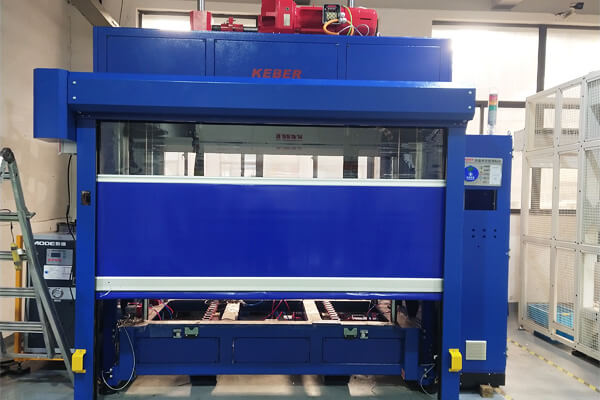
- The Speed Door Solution: Speed doors serve as machine protection barriers for robotic welding cells and stamping presses.
- Key Feature: They integrate seamlessly with AGVs (Automated Guided Vehicles) and conveyor systems, opening automatically to allow parts to pass and closing immediately to protect workers from welding sparks and noise.
Logistics, Warehousing, and Internal Transport Zones
- The Challenge: Forklifts and tugger trains frequently move between production halls and storage warehouses. Standard doors create traffic jams and allow conditioned air to escape.
- The Speed Door Solution: Installed at high-traffic cross-docking points, ラピッドロールドア facilitate fast separation between production (warm) and storage (ambient/cold) areas.
- Key Feature: Self-repairing zipper curtains are ideal here, as they can withstand accidental forklift impacts without causing downtime.
Cleanrooms and Special Manufacturing Areas
- The Challenge: With the rise of EV manufacturing, the production of lithium-ion batteries and precision electronics requires ISO-classified clean room environments and low-humidity “dry rooms.”
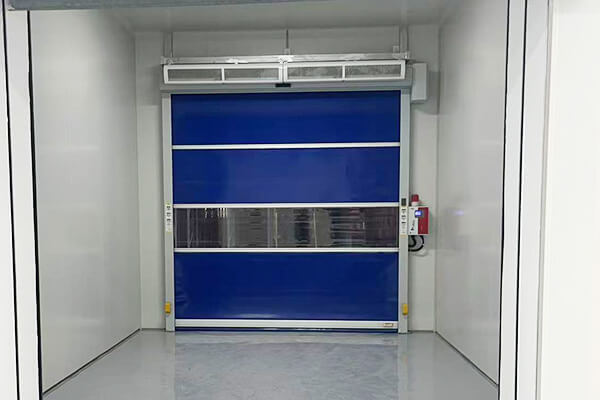
- The Speed Door Solution: Specialized cleanroom speed doors offer superior sealing capabilities and smooth surfaces that are easy to sanitize.
- Key Feature: They effectively control humidity levels and particulate counts, ensuring sensitive battery cells are not compromised by moisture ingress from the general factory floor.
Types of High Speed Doors Used in Automotive Production
PVC High Speed Roll-Up Doors

- Best For: Internal separation, Assembly Lines, and Conveyor Integration.
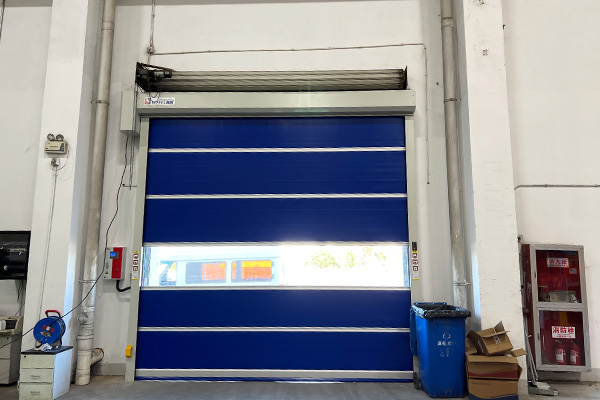
- Overview: PVC speed doors feature a lightweight, flexible curtain that allows for extremely rapid opening speeds (often exceeding 2.0 m/s).
- Key Advantages:
- High Cycle Life: Engineered to withstand thousands of cycles per day without mechanical fatigue.
- Safety Soft-Edge: The curtain usually has no rigid bottom bar, ensuring that if it closes on a vehicle or worker, it causes no injury or damage.
- Visual Management: often equipped with large transparent vision panels to allow forklifts to see oncoming traffic.
High Speed Spiral Doors

- Best For: Exterior Logistics Bays, High-Security Zones, and Design Centers.
- Overview: Spiral speed doors combine the speed of a rapid roll door with the security of a traditional aluminum shutter. They utilize a unique spiral track mechanism where the rigid aluminum slats do not touch each other as they roll up.
- Key Advantages:
- Durability & Security: The rigid aluminum panels offer protection against forced entry and high wind loads, making them ideal for external building envelopes.
- Low Wear & Tear: Because the slats don’t touch during operation, there is no surface wear, keeping the door looking pristine for client-facing areas (like car delivery centers).
- Thermal Performance: The slats are often foam-filled, providing significantly better U-values than standard PVC curtains.
Insulated High Speed Zipper Doors

- Best For: Paint Shops, Cold Test Chambers, and EV Battery Dry Rooms.
- Overview: When temperature stability is non-negotiable, insulated high speed doors with zipper track technology are the standard choice. These doors feature a multi-layer insulated curtain and a specialized zip-tooth system that locks the curtain into the side guides.
- Key Advantages:
- Hermetic Seal: The zipper track creates a near-airtight seal, preventing humidity ingress (crucial for Lithium-ion battery manufacturing) and energy loss.
- Self-Repairing Technology: If a forklift dislodges the curtain, the door automatically repair itself into the track on the next cycle, eliminating maintenance downtime.
- Climate Control: The thick, insulated curtain effectively separates climate zones, such as separating a hot oven area from a cooled assembly zone.
Comparison of Industrial Speed Door Types
The following table compares the three most common rapid speed door technologies used in the automotive sector to help you select the right solution for your specific application zone.
| Feature / Door Type | PVC High Speed Roll-Up Door | Rigid High Speed Spiral Door | Insulated High Speed Zipper Door |
| Primary Material | Single-layer PVC curtain (with metal wind bars) | Aluminium or Galvanised Steel Slats (PU foam filled) | Multi-layer Insulated Fabric (No metal bars, zipper-teeth edge) |
| Insulation & Sealing | Basic Used for physical separation; offers minimal thermal retention. | Good Solid insulated slats offer retention, though minor thermal bridging can occur between slats. | Excellent Zipper-track system creates a hermetic seal, eliminating air leakage. |
| Wind Resistance & Security | Low No anti-theft properties; internal use only. | High Rigid slats prevent forced entry and withstand high wind loads (External use). | Moderate Flexible curtain withstands wind but offers no physical security against intrusion. |
| Crash Recovery | None Metal wind bars bend upon impact, requiring manual repair/replacement. | None Rigid slats will crush upon impact; repairs are expensive and slow. | Self-Repairing (Core Benefit) Curtain automatically “re-inserts” into the track after a forklift impact (Zero maintenance). |
| Opening Speed | Fast (1.0 – 2.0 m/s) | Very Fast (1.5 – 3.0 m/s) Spiral track offers low friction for maximum speed. | Fast (1.2 – 2.5 m/s) |
| Cost Profile | Economical (Low) | Premium (High) | Mid-Range (Medium) |
| Best Application | General Internal Zones Assembly lines, conveyors, basic partitioning. | External / High-End Zones Loading bays, car delivery centres, high-security perimeters. | Climate / Clean / High-Traffic Cold storage, Paint Shops, EV Battery Dry Rooms, busy forklift lanes. |
Case Studies: PVC Speed Doors in Automotive Painting Line
To understand the tangible value of PVC High-Speed Doors, let us look at a real-world application within a Volkswagen (VW) manufacturing plant. This example highlights how the right door solution solves the critical problem of contamination and energy loss in automotive surface finishing.
The Challenge
In the automotive painting process, the environment is everything. VW engineers faced two specific challenges between the Sanding Zone and the Spray Booth:
- Contamination Risks
- Energy Inefficiency
The Solution: PVC High-Speed Doors
Following the installation, the facility reported improvements directly linked to the speed door technology:
- Defect Reduction: The rapid opening/closing cycle minimized air exchange, resulting in a measurable drop in airborne particulates and a significant reduction in paint defects requiring rework.
- Optimized Workflow: The doors integrated with the conveyor PLC. As a car body approached, the door opened instantly and closed immediately after the vehicle passed.
- Energy Stability: The HVAC system load was reduced because the internal temperature remained stable, proving that high-speed doors are a vital component of sustainable manufacturing.
FAQs
What are high-performance doors and where are they used?
High-performance doors are rapid-operating, durable access systems designed for industrial high-speed doors and commercial applications that require quick access, tight seal and long-lasting operation. These doors, including high speed fabric doors, coiling doors and rolling doors, are used in warehouses, parking garages, food processing plants for hygiene and temperature control, and other large openings where traffic flow and reduced energy loss are critical.
How do rigid and fabric doors compare for high-traffic environments?
Rigid doors typically provide heavy-duty protection and structural stability, while fabric doors and fabric high speed models deliver faster cycle times and lighter inertia for smooth operation and springless design options. For high-traffic entrances, fabric high speed and high-speed roll-up doors often enhance the flow and boost efficiency, whereas rigid or series doors suit applications needing extra insulation or impact resistance.
Are coiling doors or fold-up doors better for large openings?
Coiling doors are ideal for large openings that need a compact roll-up solution with quick access and a tight seal, while fold-up doors may be preferable when side clearance is limited or for garage door style installations. Both types support heavy-duty cycles and can be configured with safety features and springless designs to suit parking garages, loading bays and other commercial applications.
How do high speed commercial doors improve temperature control and energy savings?
High speed commercial doors minimize air exchange by opening and closing rapidly, which reduces energy consumption and helps maintain temperature control in climate-sensitive areas like cold storage or hygienic production lines. Fabric doors provide fast operation and a reliable tight seal, boosting efficiency by reducing HVAC load and maintaining consistent interior conditions for food safety and process stability.
What safety features are available for high-speed roll-up and rapid roll doors?
Safety features for high-speed roll-up and rapid roll doors include presence sensors, edge detection, safety loops, soft bottom edges, and controlled descent systems to prevent impact. Many models also offer springless design and integrated access systems to ensure smooth operation and protect personnel and equipment in high-traffic industrial environments.
Can high-performance door models handle different applications and heavy-duty use?
Yes. A wide range of high-performance doors and door models are engineered for different applications—from hygienic food processing and temperature-controlled storage to high-traffic manufacturing lines and parking garages. Heavy-duty variants and series doors are available to withstand frequent cycling, impact recovery and demanding environmental conditions while remaining long-lasting and reliable.
How do I choose the right high-speed fabric or rolling doors for my facility?
Choosing the right door requires assessing door requirements such as opening size, cycle frequency, desired temperature control, hygiene standards and required safety features. Consider fabric doors for fabric high speed performance and rapid roll benefits, coiling or rolling doors for large exterior openings and robust sealing, and fold up or sliding doors for specialized entrance configurations. Consulting manufacturers about traffic flow, boost efficiency goals and long-term maintenance will help select the optimal model.