
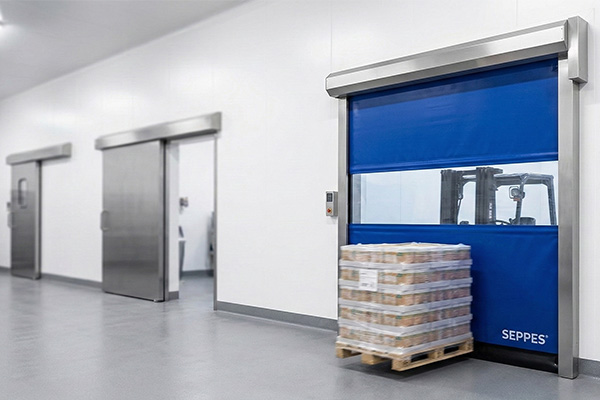

Clean Room Door Selection for Hygienic Food Factory Design: Balancing Compliance and Operational Efficiency
In environments adhering to international food safety standards such as HACCP, IFS, or BRC, the integrity of zoning is paramount. Hygienic industrial doors are not merely physical barriers; they are critical components for maintaining air pressure differentials, controlling temperature/humidity, and preventing cross-contamination. This guide explores how to select the right hygienic door and high-speed solutions to achieve both regulatory compliance and logistics efficiency.
Core Hygienic Door Types and Technical Features
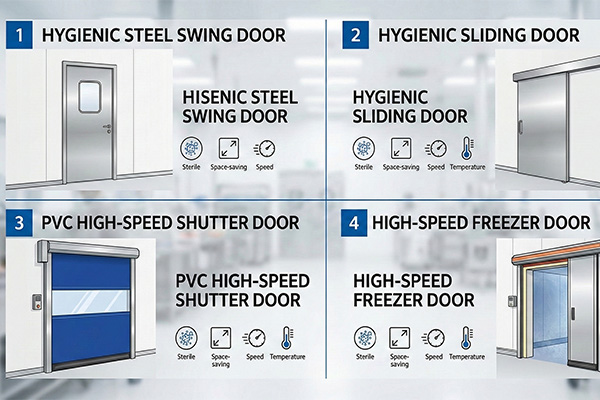
Based on the specific requirements of food processing zones, the following four hygienic door types offer distinct functional advantages:
Hygienic Steel Swing Doors
- Features: Flush-mount design to eliminate dust traps; typically constructed from AISI 304/316L stainless steel or anti-bacterial coated steel.
- Application: Personnel access, changing rooms, and high-care laboratories.
- Core Value: Superior hermetic sealing and ease of sterilization.
Hygienic Sliding Doors
-
- Features: Non-shedding track systems; manual or automated operation; space-saving lateral movement.
- Application: Clean rooms with limited swing space or large equipment entry points.
- Core Value: High structural stability and airtight performance during high-frequency use.
Puertas de persiana de PVC de alta velocidad
-
- Features: Opening speeds of 1.2 m/s – 2.0 m/s; zipper-style self-repairing structure; metal-free curtain options.
- Application: High-traffic logistics corridors (forklift access) and transition zones between clean and non-clean areas.
- Core Value: Maintaining pressure differentials by minimizing the “open-door” cycle.
High-Speed Freezer Doors
-
- Features: Insulated dual-layer curtains; integrated electric heating systems in tracks to prevent frost buildup.
- Application: Cold storage and blast freezers (down to -25°C).
- Core Value: Elimination of thermal bridges and energy-efficient operation in extreme temperature gradients.
Material Compliance: Mitigating Cross-Contamination
In High-Care Zones, the cleanability of surfaces is the foundation of microbial prevention:
- Flush-Mount Construction: Door frames must be integrated seamlessly with the wall panels to prevent the accumulation of dust and aerosols.
- Corrosion Resistance: Using AISI 304/316L stainless steel ensures the door system withstands aggressive chemical foaming and high-pressure cleaning protocols.
- Sealing Systems: Food-grade EPDM or silicone gaskets are essential to ensure no particle shedding occurs while maintaining a laboratory-grade seal.
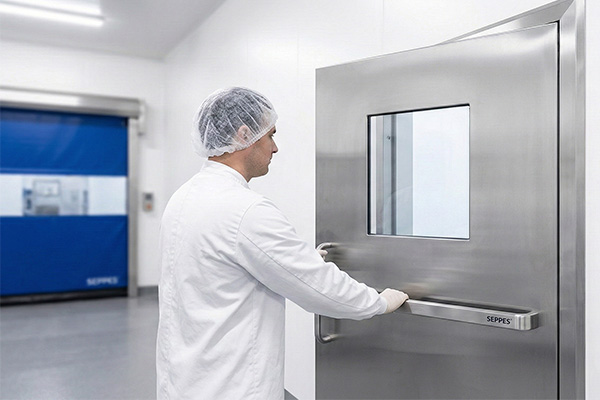
Dynamic Environment Control: Optimizing Logistics
Static sealing only addresses the door in its closed state. The real challenge lies in pressure loss during transit:
- Minimized Exposure Time: High-speed doors respond instantly, drastically reducing the exchange of air between the clean room and external environments.
- Self-Repairing Functionality: For forklift-heavy areas, a self-repairing curtain ensures the door returns to its tracks immediately after a minor impact, preventing prolonged environmental exposure.
Industrial Door Selection Matrix for Hygienic Food Factories
| Door Type | Material & Build | Speed Performance | Primary Function | Ideal Application |
| Hygienic Steel Swing Door | Features a flush-mount, anti-bacterial stainless steel surface to eliminate dust traps. | Optimized for manual or automated personnel access with smooth operation. | Provides a laboratory-grade hermetic seal for maximum environmental control. | Best for personnel-only corridors, laboratories, and high-care changing areas. |
| Hygienic Sliding Door | Built with a non-shedding track system and high-density, easy-to-sanitize panels. | Operates at a steady, controlled speed to ensure safety in high-traffic zones. | Saves valuable floor space while maintaining superior airtightness in static states. | Ideal for equipment entry points and clean rooms with limited swing clearance. |
| PVC High-Speed Shutter Door | Constructed from food-grade, reinforced PVC with a zipper-style self-repairing curtain. | Reaches extreme speeds up to 2.0m/s to minimize the open-door exposure cycle. | Prevents pressure loss and airborne contamination via rapid dynamic closure. | Designed for high-frequency forklift traffic and zones with strict pressure requirements. |
| High-Speed Freezer Door | Consists of insulated dual-layer curtains equipped with an integrated heating system. | Enables fast-cycle transit to maintain cold chain integrity without frost buildup. | Eliminates thermal bridges and drastically reduces energy consumption in cold zones. | Perfect for blast freezers, cold storage, and temperature-controlled loading bays. |
Case Study: Logistics Hub in Slovakia
In environments with significant temperature variances (e.g., a -25°C freezer adjacent to a +5°C loading bay), a dual-door system is the benchmark for efficiency:
- High-Frequency Operation: A High-Speed Freezer Door is used during shift hours. Its heated tracks prevent icing, and the 1.5 m/s speed minimizes cold air loss.
- Idle Periods: An Insulated Sliding Door is closed during non-working hours, providing maximum thermal insulation.
- Data Insight: This integrated solution resulted in a 35% reduction in thermal energy loss compared to using a sliding door alone.
Automation: Touchless Hygiene Control
- Touchless Sensors: Infrared hand sensors for personnel doors and radar/induction loops for vehicle doors eliminate the need for physical contact, reducing the risk of hand-borne contamination.
- Interlock Logic: Controlled sequencing ensures that two doors in a transition zone (Air-lock) never open simultaneously, preserving air pressure stability.
FAQs
What is a cleanroom hygienic door and why is it important in cleanroom environments?
A cleanroom door, often referred to as a hygienic door, is a purpose-built entry system that supports controlled environments by minimizing cross contamination and air leakage. These doors are engineered for clean rooms, operating rooms, labs and pharmaceutical manufacturing where control of air leakage and prevention of growth of bacteria are critical. Hygienic cleanroom doors typically feature seamless construction, non-porous surfaces such as molded fiberglass or FRP. And easy to clean panels that resist chemicals and moisture, helping facilities meet FDA and GMP requirements and maintain ISO 5 and other cleanroom requirements.
What is hygienic zoning in food manufacturing factories?
Hygienic zoning is a strategic layout approach that segregates a food plant into distinct areas based on the risk of contamination (e.g., Basic, Medium, and High-Care zones). It utilizes physical barriers, such as clean room doors and airlocks, to control the flow of personnel and materials, ensuring do not compromise the safety of clean production zones.
How do door styles like sliding cleanroom doors and hinged doors compare for demanding environments?
Door styles matter in critical environments: sliding cleanroom doors, including bi-parting and dortek’s sliding options, are ideal for automated, high-traffic areas. Hinged doors are suitable for lower-traffic access points. It can provide strong impact resistance and long-lasting performance when fitted with neoprene seal jambs. Both swing and sliding doors can be configured for heavy usage. But doors designed for demanding environments often include automatic cleanroom doors or high-speed cleanroom doors to balance throughput and contamination control.
What materials are used for a door panel in hygienic cleanroom doors and why?
Door panels in hygienic cleanroom doors are commonly made from seamless, non-porous materials like molded fiberglass, FRP, or corrosion-proof steel doors with hygienic coatings. Polycarbonate vision panels and stainless steel components offer impact resistance and chemical resistance to withstand cleaning regimes and cleaning chemicals.
Why are high-speed doors essential for maintaining clean room pressure?
High-speed zipper doors are critical because they minimize the open-door time during logistics transitions. By operating at speeds up to 2.0m/s, they ensure that the air pressure differential remains stable, even during high-frequency forklift traffic.
How do doors designed for pharmaceutical manufacturing differ from standard doors?
Doors designed for pharmaceutical manufacturing are specially engineered to meet stringent cleanroom requirements. Including resistance to cleaning chemicals, seamless construction, and control of air leakage. These doors support GMP and FDA standards, often include vision panels for observation without entry, and may be double doors or bi-parting for material transfer. Materials like molded fiberglass, FRP, or corrosion-proof steel are chosen to prevent cross contamination in labs and pharmaceutical areas.
What door configuration and activation devices are recommended for labs and operating rooms?
Common door configurations for labs and operating rooms include single hinged doors for personnel, double doors or bi-parting sliding doors for material and equipment transfer, and hermetically sealed automatic cleanroom doors for sterile areas. Activation devices such as touchless sensors, push plates, and foot-operated switches reduce contact and contamination risk. Doors are engineered to work with jamb seals, neoprene seal systems, and control of air leakage to maintain environmental conditions required in critical environments.
How should hygienic cleanroom doors be cleaned and maintained to ensure easy cleaning and longevity?
Hygienic cleanroom doors are maintained through regular cleaning regimes using approved cleaning chemicals. Because doors are seamless and non-porous, routine wiping of door panels, frames, vision panels, seals. And hinges prevents build-up that could foster bacterial growth. Periodic inspection of seals, hinges, and activation devices ensures doors continue to perform in high-usage areas and maintain airtight performance critical to cleanroom environments.


 Spanish (Mexico)
  English
  Chinese
  Arabic
  German
  French
  Uzbek
Uzbek  Russian
  Japanese
  Korean
  Spanish (Peru)
  Spanish (Venezuela)
  Spanish (Ecuador)
  Spanish (Puerto Rico)