
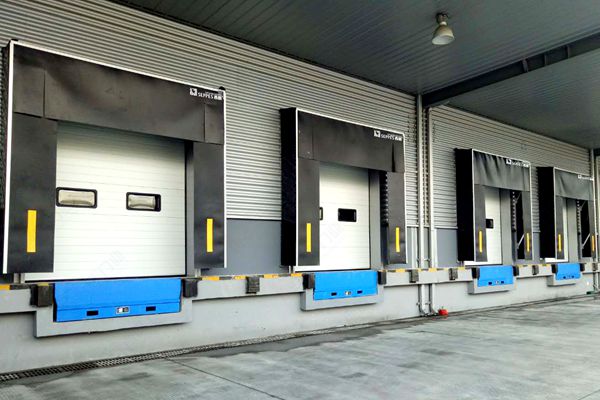

Dock Leveler For Warehouse: Heavy-Duty Load-Bearing & Smooth Transition for Efficient Cargo Handling
Dock levelers are usually used in stations, docks, logistics warehouses, cold storage, and enterprise three-dimensional warehouses. Mainly through the joint work of the control system. The electro-hydraulic power unit, the adjustment plate and the tongue plate, the height difference between the bottom plate and the platform of different transport vehicles can be effectively adjusted. The forklift works on it and has a certain stability. In addition, dock leveler for warehouse can also be interlocked through the linkage with the dock door seal and sectional door. Reduce the entry of rainwater and dust into the warehouse to ensure the cleanliness of the warehouse.
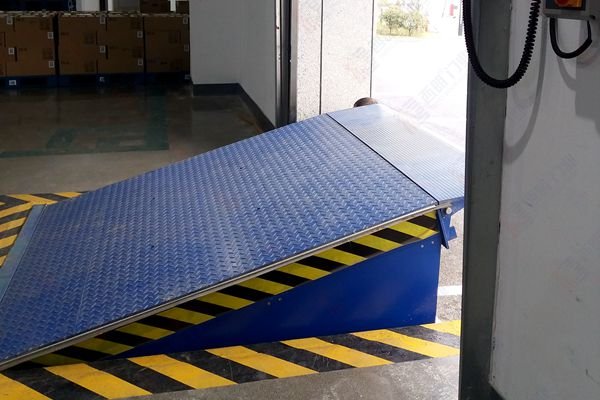
Basic Information Of The Loading Dock Leveler
| Kategorie | Details |
| Standard Size | W2000mm×L2000mm×H500/600mm; W2000mm×L2500mm×H500/600mm |
| Standard Load | Customized: 6T / 8T / 10T |
| Safety Device | Emergency stop button; Tongue plate buffer device; Side anti-pinch protection; Geomagnetic valve anti-fall device protection |
| Color Style | Blue, black; Customized upon request |
| Composition | Main board, tongue plate, hydraulic pump, oil cylinder, sealing rubber strip |
Types of Dock Levelers For Warehouse
Hydraulic Dock Levelers

Die hydraulic dock leveler is an ideal choice for busy and high-frequency loading docks. They operate with a hydraulic system and are usually driven by motors. The leveler can be raised or lowered simply by pressing a button. This automated design makes its operation simple and highly reliable.
Main Characteristics:
- By pressing the button, the electric dock leveler will start running.
- Sustained effortless operation over long hours.
- The stable structural design enables it to carry high-load goods.
- Maintenance input over time will be less.
Ideal Use Case: These are perfect for facilities with constant loading/unloading area. Its durability and high performance can ensure stable operation. For operations that prioritize efficiency, hydraulic dock leveler is a wise investment.
Mechanical Dock Levelers

Mechanical dock levelers are renowned for their simple structure and economic efficiency. Unlike hydraulic dock levelers, it uses a spring and zipper system to lift and fix the leveler. An operator manually pulls the chain to release the lock, allowing the spring to raise the deck. The operator then uses their body weight to walk the deck down onto the truck bed.
Main Characteristics:
- Ergonomic pull-chain operation.
- Lower initial cost.
- No need for electrical power.
- Making installation simpler.
Ideal Use Case: Mechanical dock levelers meet the demands of warehouses with relatively small foot traffic. It is a reliable solution for enterprises seeking cost-effectiveness with core functions and security.
Telescopic Dock Levelers

The telescopic dock levelers are an advanced solution, specifically designed for precise positioning and heavy-duty applications. Unlike standard hinged-lip levelers, these feature a lip that extends outward telescopically. This allows for a longer reach and the ability to service loads that are not perfectly position ed at the dock opening.
Main Characteristics:
- The extended lip design enhances the working range and accuracy.
- Superior strength for heavy-duty cycles.
Ideal Use Case: They are essential for operations that require exact placement of the leveler lip. Such as when dealing with fragile goods or when trucks cannot park flush against the dock bumpers.
Edge-of-Dock Levelers

When space is limiting, edge-of-dock levelers are an excellent alternative. These compact units are mounted directly to the face of the loading dock, saving valuable floor space.
Main Characteristics:
- Space-saving design.
- Simple installation.
- Lower cost compared to pit levelers.
Ideal Use Case: Edge-of-dock levelers are best suite d for warehouses with standardized truck fleets, where there is minimal variation in trailer height. They provide a safe, efficient bridge in a compact package.
Vertical Storing Dock Levelers

Vertical storing dock levelers are the premier choice for facilities with strict climate control or hygiene requirements. When not in use, the vertical dock leveler is stored vertically inside the building. In this way, the upward-flipping door can be directly close d at the bottom of the pit, forming a perfect seal to prevent energy loss and pollution.
Main Characteristics:
- Outstanding environmental control, completely sealed doors, enhancing security.
- Improve cleanliness by preventing debris from entering the stacking pit.
Ideal Use Case: These are indispensable for food and beverage distribution centers, pharmaceutical facilities, and any temperature-controlled warehouse where maintaining internal conditions is a top priority.
The Core Benefits of Integrating Dock Levelers in Your Warehouse
Enhanced Safety for Workers and Equipment
A key benefit of warehouse dock levelers is the increased safety in the workplace. A hazardous gap can develop between the platform and the trailer if not leveled properly and can result in nasty accidents. The warehouse dock levelers can smooth out the gap and minimize these risks.
- Prevents Forklift Accidents
- Reduces Worker Injuries
- Secures Loads
Increased Efficiency in Loading
Pit dock leveler has established a smooth operation channel. Allow forklifts to move goods more quickly, thereby reducing the time each truck stays on the loading and unloading platform. It can achieve faster and smoother flow of goods, directly enhancing the efficiency of your warehouse.
Versatility for Handling Various Trucks and Loads
Trucks and trailers come in many shapes and sizes, with bed heights that can vary significantly. A dock leveler provides the flexibility needed to service nearly any vehicle that arrives at your dock.
- Accommodates Different Heights: Dock levelers are design ed to adjust to the heights of different trailer beds, ensuring a safe and level connection every time.
- Manages Diverse Loads: Whether you’re moving heavy pallets, delicate goods, or awkwardly shaped items, a stable dock leveler provides the solid foundation needed for safe and efficient handling. This versatility is crucial for warehouses that deal with a wide range of carriers and products.
Long-Term Cost Savings
High-quality dock levelers deliver long-term cost savings that provide a strong return on investment. A more efficient and safer dock environment experiences fewer accidents and equipment failures, which leads to less operational downtime and associated costs. Investing in a durable leveler prevents costly interruptions and keeps your supply chain moving.
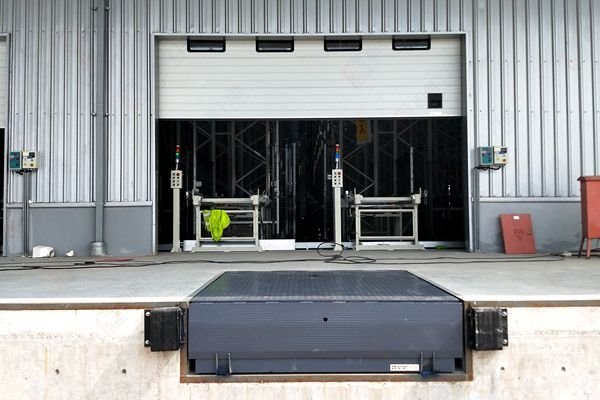
Recommended Dock Leveler Manufacturer
Seppes establishes for over 14 years, focusing on loading dock product development and production. Seppes dock leveler products have passed CE certification and SGS certification. So, our products have been exporte d to 75 countries, such as the United States, South Korea, Brazil, Saudi Arabia, Argentina, Guatemala, Singapore, Europe and others.
Dock Leveler Frequently Asked Questions
1. What is the purpose of the dock leveler in a warehouse?
A dock leveler serves as a crucial bridge between the warehouse’s loading dock and the bed of a delivery truck or trailer. Its primary purpose is to create a smooth, stable, and level surface, allowing forklifts and other material handling equipment to move safely and efficiently between the facility and the vehicle. This eliminates the dangerous gap and height difference, which helps prevent accidents, protect workers from injury, and avoid damage to both equipment and goods during loading and unloading.
2. What is the standard dock height for a warehouse?
While there can be some variation, the industry standard height for a loading dock in a warehouse is typically between 48 and 52 inches (or 4 to 4.3 feet) from the ground. This range is designed to align with the bed height of most standard semi-trailers and trucks, facilitating easier loading operations.
3. What is a dock plate in a warehouse?
A dock plate is a simple, portable, and cost-effective solution for bridging the gap between a dock and a trailer. Typically made of aluminum or steel with a slip-resistant surface, a dock plate is a flat sheet of metal manually place d to cover the gap. Unlike a dock leveler, it is not fixe d to the dock and is generally intende d for lower-volume applications with manual equipment like hand pallet jacks. It is not recommended for use with powered equipment like forklifts due to its limited capacity and stability.


 German
  English
  Chinese
  Arabic
  Spanish (Mexico)
  French
  Uzbek
Uzbek  Russian
  Japanese
  Korean
  Spanish (Peru)
  Spanish (Venezuela)
  Spanish (Ecuador)
  Spanish (Puerto Rico)